
WAGNER Switzerland AG




" Fifty Shades of Grey " is a moderately boring movie about teen fantasies concerning first sexual experiences with the opposite sex. " Grey Orange " be more exciting for some: a global provider of AI-powered software for warehouse control and inventory management, whose " GreyMatter " software Dematic now wants to profit from.

" Iterative " is the magic word that the southern German supermarket chain V-Markt used to implement the Wamas Core WMS warehouse management system from SSI Schäfer for the smooth supply of its southern German branches. This minimized risks during ongoing operations.

Circulating in the millions, Euro pallets are an integral part of everyday life in industry, trade, and logistics. However, A and B grade pallets are becoming increasingly scarce, warns the logistics provider Dachser. This has repercussions for costs, planning reliability, and delivery capacity along the entire supply chain.

Even after a malfunction was resolved on Wednesday, the screens at Swiss air traffic control remained fixed the technical problem at the

Materials handling specialist Ferag focuses on a holistic approach to warehousing and the targeted use of technologies to automate defined fulfillment processes in order to improve order processing efficiency. The concept developed by Ferag Solutions is based on a new key performance indicator, " CoOF " (Cost of Order Fulfillment).

The Swiss Logistics by ASFL SVBL training center in Rupperswil recently hosted visits from Federal Councillor Beat Jans, head of the Federal Department of Justice and Police, Jérôme Cosandey, head of the Directorate of Labour at SECO, and Aargau government councillor Dieter Egli.

At the world's largest industrial trade fair in Hanover, with 3,000 exhibitors, a young company called BTRY from Dübendorf won a startup award sponsored by the logistics provider Hermes. The founders impressed the judges with an ultra-thin, fully flexible energy storage system that is intended to enable numerous new applications.

At Claas in Bad Saulgau, machines for forage harvesting and headers for the forage harvester, which proudly bears the name " Jaguar ," are developed, tested, and manufactured. More staging area was needed at the assembly lines. Bito assisted with the switch to the large SL 86 hoppers.

Automation, as mentioned, doesn't have to be complicated. Even simple, repetitive logistical processes can be carried out automatically with high-lift pallet trucks like the EXV iGo. Forklift manufacturer Still successfully implemented this at DP-Supply, a subsidiary of Deutsche Milchkontor DMK.

It was just one of the numerous presentations at the German Material Flow Congress, which took place in Dortmund these days in parallel with the IFOY Test Camp: It was dedicated to a concept by Carl-Friedrich Rico zu Knyphausen, Managing Director & Co-Founder of Logivalue GmbH in Berlin: A « Retail Town House » for the city center.
The shift to rail freight through the Alps has suffered significant setbacks recently. According to BLS Cargo, the main culprits are the dilapidated German infrastructure and the numerous line closures and construction sites along the north-south corridor. This is also impacting personnel policies.
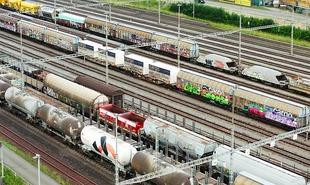 Photo: SBB
Switzerland, according to the company founded in Bern in 2001 with around 400 employees and 150 locomotives, has done a great deal in the past 25 years to promote the shift to rail transport. However, Swiss modal shift policy is now at a turning point. It is high time for new political impetus.
Relocation policy under pressure
The Swiss Transport Workers' Union (SEV) is also warning against further delays in the shift of freight traffic from road to rail, given the financial results of BLS and BLS Cargo. Due to cost-cutting pressures in regional passenger transport and the downturn at BLS Cargo – partly caused by the premature discontinuation of the rolling highway service between Fribourg and Novara (RAlpin) – the BLS Group is currently reporting a loss of 10.3 million Swiss francs. After two years with group profits exceeding 20 million francs each, this is "unpleasant " as they say, but "manageable " If only.
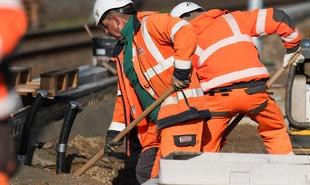 Track work in Germany. Photo: DB
The situation is serious: 15-20% of BLS Cargo trains are currently cancelled, meaning a reliable service can no longer be offered to customers. Adding to the unstable operations are rising costs for freight railways because locomotives and drivers can no longer be deployed efficiently. Despite the poor availability of infrastructure, track access charges continue to rise relentlessly in all countries, cancellation fees are being levied, and the demands on the expensive Electronic Train Management System (ERTMS) are increasing.
Demands on the DB colleague
, the control and construction site and maintenance management of the German network operator DB InfraGO play a crucial role: only when track interruptions are significantly reduced, diversions are provided, renovations are shifted to low-traffic periods and track access charges are kept constant – only then can freight railways like BLS Cargo stabilize their operations and contribute to modal shift again.
 DB CEO E. Palla. Photo: DB
Because it appears that the next two to three years will also be characterized by extremely intensive construction activity, BLS Cargo, together with the industry, is in close contact with the management of DB InfraGO. The freight industry, particularly in combined transport, recently addressed an open letter to the new CEO of Deutsche Bahn, Evelyn Palla, and the German Transport Minister, Patrick Schnieder . Dirk Stahl, President of the ERFA (Experience Exchange), co-signed the letter. The message: This situation cannot continue.
Wanted: Relocation policy 2.0
The shift of freight transport from road to rail must not decline further. If more and more transport is shifted back to the roads, not only is the transport system at risk of collapsing in certain areas, jeopardizing security of supply and the stability of logistics chains, but important sustainability goals could also be missed.
There is undeniably a modal shift crisis in freight transport – in Switzerland and throughout Europe. Policymakers are called upon to find effective solutions quickly. Only by modernizing the northern feeder lines to such an extent that reliable and stable operations are guaranteed and the structural cost disadvantage of rail freight is significantly reduced can the modal shift back to rail be stopped.
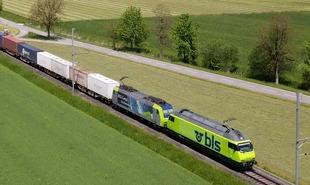 Photo: BLS
For the planned closures of the Rhine Valley Railway during peak traffic periods in the coming years minimum capacity guarantees, compensation funds, and the suspension of cancellation fees and track access charges in cases must be negotiated with the infrastructure operators and transport ministries . CO2 compensation, from which rail freight currently benefits, should be further expanded. According to the latest forecasts, Switzerland will significantly miss its 2030 climate targets . The transport sector is responsible for this – notably.
"Don't cut corners on staff"
According to the SEV union, strengthening rail freight will only succeed with highly motivated staff. Good working conditions, adequate qualifications, and high safety standards are essential prerequisites for reliable rail operations. " Attempts short-term competitive advantages over road transport through deregulation, increased pressure on staff, or lowered requirements are misguided " says Barbara Keller, Vice President of the SEV. " Anyone who is serious about shifting freight to rail must invest in the railways – and not cut corners on staff."
 B. Keller. Photo: private/courtesy of B. Keller
Together with the European Transport Workers' Federation (ETF), the SEV aims to further strengthen rail freight transport at the European level. The ETF has launched the #SaveRailFreight campaign for this purpose. It consolidates the demands of European railway unions for increased public investment and the preservation of an efficient rail freight system. The goal is to prevent further shifts to road transport.
Alternative routes are being developed
At least: By 2028, the German Stuttgart–Singen line and its Swiss extension Schaffhausen–Oerlikon–Othmarsingen are to be upgraded to relieve the German Rhine Valley line and serve as an alternative route. Following a declaration of intent this year, work has begun with France to develop the left bank of the Rhine line into a modern and efficient feeder line for freight traffic. On the Swiss side, two tunnels near Basel will be upgraded for this purpose; the main construction work is scheduled to begin in 2026.