WAGNER Switzerland AG




German technology remains highly regarded when it comes to rapid material handling, the elimination of weaknesses, and service quality. Following successful projects in Oklahoma and Texas, the steel trader " Steel and Pipe Supply " once again relied on saws and storage systems from the Rhine Valley in Kansas City.

Bito is launching an offensive with an economical alternative for companies that want to re-equip, expand, or temporarily supplement their warehouse and production areas, but don't want to tie up their capital long-term: renting instead of buying is the motto. The advantages – especially in " dynamic times " – are obvious.

Logistics provider Yusen is presenting an expanded global platform for the healthcare sector at LogiPharma in Vienna, where companies such as Novartis, Bayer, Takeda, and hospital supplier UCB are currently participating. The platform focuses on the professional delivery of specialized healthcare solutions.

Coop's own rail connection for urban logistics in Zurich, streamlined logistics vehicles and the outsourcing of all operating room logistics in a cooperation between the Seeschau Clinic and the Swiss Post are the projects that are entering the final sprint for this year's Swiss Logistics Award from GS1.

Compressed air has traditionally been used primarily for fixed installations. Schmalz's vacuum grippers also mainly operate with lines that often have to run across halls and facilities. However, mobile robotics increasingly requires flexible solutions – a need that Schmalz now intends to address more effectively.

Safelog, the specialists for software for controlling intralogistics processes, have entered into a cooperation with the drive experts from SEW Eurodrive at LogiMAT in order to jointly develop a high-performance software for controlling mobile and stationary processes in intralogistics.

“Never walk alone” could be the motto of a networking event hosted by the consulting experts from “Adnovum”, where the Digital Product Passport (DPP), cybersecurity and IT opportunities with Petra Merino (GS1 Switzerland) and security expert Andreas Achterholt are on the agenda on May 7th in Zurich.

With a new workshop in Obersiebenbrunn near Vienna, rail manufacturer Stadler is expanding its capacity for the commissioning, approval, and servicing of modern rail vehicles in Austria. The workshop has been used to maintain Westbahn's high-speed trains since March 2026.

Idealworks, part of the Munich-based Agile Robots Group, with more than 1,700 AMRs and AGVs worldwide and one of the pioneers in industrial automation through AI in robot-controlled logistics processes, has founded a US company headquartered in Greenville, South Carolina.

At LogiMAT, conveyor technology provider Interroll attracted attention with a new chain-belt sorting system developed after the acquisition of Sortteq. Together with MCP Play, this creates a material flow ecosystem that combines single-item transport with intelligent sorting.
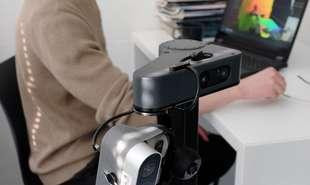
Chaotic storage is still considered a prime example for those too lazy to search. At the Technical University of Munich (TUM), a robot has now been developed whose primary task is to track down missing items. According to TUM, it's one of the first robotic companions that not only integrates image understanding but also meaningfully connects it.

Attaching a tracker with RFID, Wi-Fi, and a barcode to every conceivable object and item is clearly not the obvious solution here. Instead, the robot from Professor Angela Schoellig's TUM Learning Systems and Robotics Lab, which has a camera mounted on its top, combines information from the internet with a spatial map of its environment.
To find something, the robot has to look around and create a three-dimensional image of the room. The camera initially delivers two-dimensional images, but their pixels also contain depth information.
Pixels with depth information
This creates a three-dimensional image of the environment accurate to the centimeter, which is constantly updated. A laptop also provides the robot with information about which objects are visible in the image and what significance they have for humans.
“ We taught the robot to understand its environment ” says Angela Schoellig. The vision of the head of the robotics lab at the TUM Chair of Safety, Performance and Reliability for Learning Systems is to develop robots that can navigate independently in any environment. Humanoid robots working in factories, or robots in care settings that move between different homes, require this newly developed basic understanding, which, “ is important for all robots that move in constantly changing spaces ” —that is, in dynamic environments.
 Photos: TUM
Based on internet information, the robot understands that a table or windowsill could be used to briefly set down a specific item, while a stovetop or sink would be unsuitable. " The language model incorporates the relationships between the objects, and we translate this information into the robot's language " explains Schoellig. Small two-digit numbers appear on the three-dimensional map of the environment, constantly recalculating the probability of the sought-after object being located there.
In a dynamic environment
The robot then searches the likely locations almost 30 percent more efficiently than if it searched randomly around the room, according to the research findings. Artificial intelligence is thus used in two ways: firstly in image recognition, and secondly through the use of a language model. A demonstration of the search robot was on display at the German Robotics Congress in Cologne until Friday.