behind Linde MH's World of Materialhandling is that visitors for a quick visit by the exhibitor's booth . Whether it's sunny or pouring rain, they 'll experience realistic applications live.At the N20 event in Mannheim, the focus is on the question: Which mode will it be?
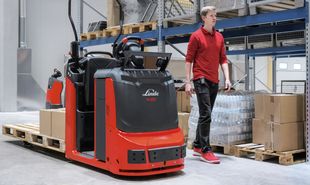
Short walking and driving distances increase the efficiency of order picking. Logistics service providers and retail chains can now fully exploit this optimization potential with the Linde N20 SA and N20 C SA semi-automated order pickers. The new (semi-automated) option offers two driving modes in which the vehicles automatically follow or precede the operator. The result: employees are relieved of non-value-adding tasks. Picking performance, it is said, increases by up to 20 percent.
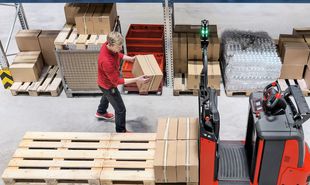
Order picking is labor-intensive and demands stamina and attention from warehouse staff. A significant portion of the process involves walking between the shelves and the picking machine. This activity, unlike picking the goods from the shelf and placing them on the pallet, does not add value. Even a few seconds lost during each handling operation add up to significant time losses over the course of the workday. "Even just a few steps, repeated over and over, tire the operator and rob them of energy that would be better used for completing the picking process flawlessly," points out Philipp Stephan, Product Manager Automation & Intralogistics Solutions.
 A detour into IT
At the same time, picking rates need to be increased, error rates reduced, and health problems prevented. This means the order picking process offers significant potential for increasing the overall efficiency of warehouse logistics – optimization potential that is now being unlocked with the SA option for Linde order pickers with a load capacity of up to 2.5 tons. Both driving modes aim to significantly shorten travel and walking distances during order picking in the aisle. Simultaneously, the tiring process of getting on and off the vehicle is eliminated, thus reducing the risk of accidents. This has positive effects on throughput and productivity in the warehouse.
One of the most common processes in high-bay warehouses is order picking along one side of the racking, where an employee walks the aisle in a U-shape. This activity is supported by the semi-automated "follow-me" function. When the person stops, the vehicle also stops, allowing them to place the goods directly from the racking onto the pallet. When the operator continues walking, the truck resumes its journey. The workforce moves along the racking, collecting goods without having to constantly walk back and forth to the driver's station. The truck's movement is triggered when the employee passes a specific point on the vehicle, thus crossing the so-called "virtual wall.".
 Photos: wl
If the vehicle needs to be loaded from both sides, the "stop-and-go" function is ideal. The vehicle travels at a constant speed in the center of the aisle and is guided forward by a remote control, ideally worn on the operator's belt. The operator then walks back and forth behind the vehicle between the shelves to pick up or put down goods – a method preferred in smaller warehouses. Another advantage is that there's no need to walk back to the operator's station, nor is there the need to get in and out of the vehicle.
Both functions are based on ultra-wideband radio technology and can be adjusted with centimeter precision. At the end of the aisle, the vehicle stops automatically to avoid collisions with other vehicles. By entering the vehicle, the operator ends the semi-automatic mode and moves the vehicle manually to the next aisle. Since one of the biggest concerns regarding automated vehicles is safety, the N20 SA and N20 C SA order pickers are equipped with a high-performance safety scanner that detects people and other industrial trucks. Mounted low on the chassis, the scanner also detects unexpected obstacles. To prevent damage to shelving and provide the operator with sufficient space, the vehicle maintains a minimum distance of 50 centimeters from the shelving, but can also be positioned further away at the beginning of the aisle. The functions are largely familiar from the comparable vehicle type of the Hamburg-based sister company under the KION umbrella – but are nonetheless characterized by high efficiency in operation.
www.linde-mh.de