K. Althoff
The German Federal Association of Logistics (BVL) claims an important role as a pioneer in the industry at the start of this year's logistics congress in Berlin and its new form as BVL Supply Chain CX with 2600 participants at the Estrel and the new concept with 140 exhibitors.
Visitors, exhibitors, and industry professionals will experience over 220 speakers across eight stages until Friday, as well as a new exhibition area with extensive networking opportunities, activities, and a party atmosphere. BVL Managing Director Christoph Meyer: “The target audience for the event has been significantly expanded – firstly to include younger specialists and managers, and secondly to include new sectors that make supply chains possible in the first place – HR, IT, tech companies, and insurance. We have already grown considerably compared to previous congresses and have begun to leverage this potential at the Estrel Hotel. Given the current economic situation and our limited resources as an association, we are very pleased with this year's inaugural BVL Supply Chain CX.”
Among the numerous top speakers in the Congress Area are DHL CEO Tobias Meyer, Jens Spahn, Deputy Chairman of the CDU/CSU parliamentary group in the Bundestag, Ilse Henne, Member of the Executive Board of thyssenkrupp, Antonio Krüger, CEO and Scientific Director of the German Research Institute for Artificial Intelligence (DFKI), Kay Schiebur, Member of the Executive Board of the Otto Group and DPD CEO Karsten Schwarz.
The traditional highlight is once again the presentation of the German Logistics Award on Wednesday evening. All participants of the BVL Supply Chain CX are then invited to meet on Thursday evening for the big CX party in the Expo Area. In addition, there are numerous offerings such as moderated "Connect Tables," sessions for "Young Professionals" and "Ladies in Logistics," as well as a convenient matchmaking function in the new BVL Events app.
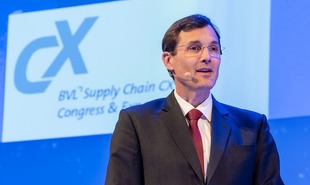 DHL CEO T. Meyer. Photos: Ch. Lietzmann
In his opening remarks, the new CEO of the German Logistics Association (BVL), Kai Althoff, characterized the current state of logistics in Germany as the third largest economic sector after retail and the automotive industry, with a value of approximately €330 billion and about 8% of Germany's economic output, as well as 25% of the European logistics market. Growth in the sector in Germany has recently been very weak (1.2% nominal growth in 2024) and even declining in real terms (-3% in 2024). Based on figures presented today, the logistics experts expect nominal growth of 1.3% for 2025, which corresponds to stagnation in real terms (-0.1%).
Althoff: “Of course, we would like to see more growth, but (…) we are also seeing positive signs again: According to the logistics indicator from the BVL and the ifo Institute, the business climate and expectations are above the current business situation for the first time in three years.” Overall, the logistics sector in Germany is well positioned to remain a key pillar of the German economy in the future and to further expand this role. Logistics experts predict that, with its industry-specific innovations, for example in the area of automation, German logistics will maintain its leading position worldwide. Logistics can also contribute to achieving sustainability goals. We expect a recovery with renewed growth in 2026.”
“A prerequisite for the future positive development of logistics is that the necessary framework conditions are established,” said Kai Althoff. “To better leverage the industry’s enormous potential as a significant pillar of the German economy, the BVL will strengthen its network with political decision-makers in the future.” The focus will be on infrastructure, digitalization, the shortage of skilled workers, the energy transition, and global supply chains due to their importance to logistics.
Increased investment in transport infrastructure is cited as an example, where there is an investment backlog of €100 billion annually over the next few years. In rail transport alone, per capita investment in many other European countries is three to four times the amount spent in Germany. Further priorities regarding necessary investments include expanding the infrastructure for alternative drive systems and promoting corresponding initiatives
Technologies. Fortunately, Germany (unlike with private cars) is doing well in European comparisons when it comes to new registrations of electric trucks. Althoff: "Nevertheless, we urgently need the corresponding charging infrastructure and subsidies for fleet modernization.".
Particular attention should be paid to deregulation and reducing bureaucracy. Simplifying and accelerating approval processes, for example for the installation of PV systems on logistics properties, as well as revising complex regulations such as the Supply Chain Due Diligence Act, must be a priority.
With regard to professional qualifications, the industry is experiencing a significant shortage of skilled workers, with around 100,000 open positions. The shortage of drivers alone causes additional annual costs of approximately €10 billion for the German economy. Althoff stated: "As the BVL (German Logistics Association), we are calling for a strengthening of skilled worker migration – the logistics sector has always been international and characterized by the collaboration of diverse cultures. Not only in light of demographic change, but also because we urgently need and expressly welcome the targeted immigration of qualified professionals.".
Trade restrictions dramatically increase the risks to supply chains. The long-term competitiveness of European companies cannot be secured through reduced global trade, but only through the free movement of goods and an improvement in the aforementioned framework conditions. Policymakers must advocate for this.