This year's IFOY Award competition in the category "Integrated Customer Solutions", which focuses on the success of integrated overall solutions, sees an exciting head-to-head race between Agilox's robot fleet at BMW and Mercedes' Factory 56.
In Regensburg, BMW operates one of the most modern automotive production plants in Europe, covering a total area of more than 1.4 million square meters. Up to 1,000 vehicles from the 1 Series, X1, and X2 are delivered daily. The project, launched at the IFOY trade fair, utilizes 27 Autonomous Mobile Robots (AMRs) from Agilox. According to the company, this is one of the largest AMR fleets currently operating in German-speaking countries, supplying production lines in the automotive sector. In an average week, the swarm moves approximately 2,624 tons of material, covering around 3,294 kilometers.

Before the Agilox AMR was implemented, the production lines were supplied using tugger trains. Buffer storage was restocked manually. Stations could only be accessed and restocked within a defined cycle. As part of a pilot project for robot-assisted transport solutions, the first AMR was installed in 2017 and, after a test phase, gradually expanded to a smaller fleet.
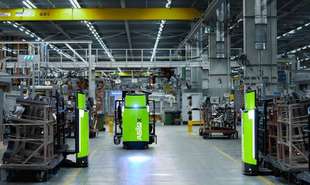 Agilox at BMW
The workstations are now stocked on demand. For short-term needs, production employees can also add individual parts to the order list. The solution is based on "X-Swarm Technology"a swarm intelligence system where computing power and material flow orchestration are distributed across the individual devices. This allows the individual AMRs to communicate and interact with each other. If one device fails, the remaining robots ensure the flow of goods.
«Low Cost from German hands
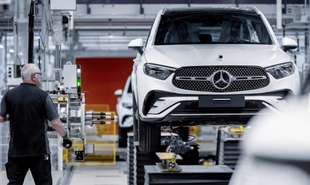
At Mercedes' Factory 56, equipped by Safelog, driverless transport vehicles (AGVs) ensure production supply in significantly larger numbers by driving underneath the payload. There, 350 AGVs (Autonomous Guided Vehicles) already transport "low-cost automation" parts and components "as if by magic" approach.
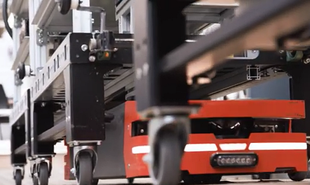
Managing Director Mathias Behounek couldn't resist the quip that this was a German quality product "at a Chinese price" They hadn't wanted to invest in a full-blown swarm technology, but simply wanted to improve the efficiency of handling recurring transport tasks. The result, of course, is that the manufacturer of such AGVs naturally wants to sell as many units as possible. However, in this particular case, as all those involved at the IFOY test camp in Dortmund unanimously agreed, the concept was so effective that the number of robotic vehicles in the fleet could already be reduced by 25 percent thanks to the clever software-controlled work distribution in the central computer.
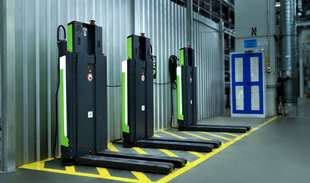 Agilox charging station
A digital twin, using a real-time monitoring system, allows for real-time tracking of the AGVs' location and status down to the second. Interfaces to the central computer ensure secure IT control. A "ghost track" provides a historical view of the shop floor at any given point in the past. This enables more in-depth analysis of past data, allowing for the identification and improvement of bottlenecks and inefficient processes. This quickly identifies and explains the causes of line stoppages. Statistically, this has already resulted in 40 fewer assembly line stoppages per year – which can otherwise quickly add up to losses in the millions over the course of a year.
The group is said to already have over 3000 of these standardized robots in use, serving a wide variety of supply processes.
(The IFOY nominations presented here in no particular order are based on our own inspection of the devices, the test camp and the on-site audit, and do not allow any conclusions to be drawn about the result of the anonymous electronic final vote of the jury before the closing gala in Baden, Austria).