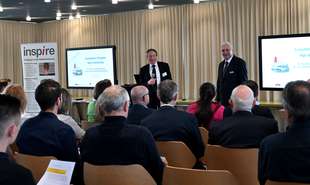
Around 60 interested participants attended this year's logistics colloquium hosted by Acel & Partner at ETH Zurich. Three presentations covered topics such as virtually CO2-free steel production using hydrogen,tool recycling, and the restructuring of a supply chain at a sporting goods manufacturer.
Acél & Partner organized the annual colloquium in the lecture hall foyer of ETHZ in collaboration with the Institute for Machine Tools and Manufacturing (IWF) and its flagship projects under the heading "Agile & Sustainable".
Fabian Gerdes, Head of Outbound Logistics at Salzgitter Flachstahl GmbH, spoke in "Logistics for Circular Solutions" about the possibilities of transporting steel and raw materials sustainably in closed loops and the contribution that steel production can make to achieving climate goals. The Salzgitter Group's proprietary concept, "Salzgitter Low CO2Steelmaking (SALCOS), features a "process" over 95% by 2033byto reduce CO2 emissions
The next challenge lies in transporting these "green" products in a truly "green" way: Approximately 11.5 million tons of material are transported inbound annually, and around 3.25 million tons outbound, by rail, truck, or inland waterway vessel. Transport volumes are increasing, while the overall infrastructure remains stagnant. Salzgitter Flachstahl has taken matters into its own hands, developing sustainable and innovative solutions, including a new train inspection concept called "Ontrail"—camera bridges that use AI to detect damage to train covers and ensure that goods arrive dry at the customer's location. The company is also developing an electrically powered inland waterway vessel capable of operating even in low water conditions.
Rico von Burg, Product Manager at Fraisa SA in Bellach, spoke about the logistics of tool reconditioning. Fraisa specializes in the production of precision tools, including custom-made tools, and the refurbishment of worn tools.
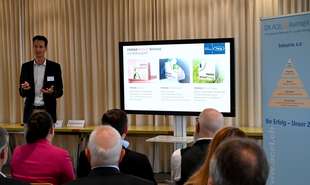 RvBurg (Fraisa)
With the "Fraisa ReTool" service, tools can be reconditioned 2.3 times. To ensure the one-piece flow functions smoothly with approximately 350,000 reconditioning processes per year, and to accommodate unique and complex tool geometries or individual customer requirements, a DataMatrix code containing all product information is used. Digital processes and the use of freshly reconditioned tools result in CO2 savings of over 50% compared to newly manufactured tools.
Peter Rutishauser, founder of Equatis AG, presented the rebuilding of a Europe-wide supply chain after the previous supplier went bankrupt. Rutishauser illustrated his presentation using the example of Trisport, a company that distributed Kettler-branded fitness equipment. The problem: Kettler had to file for insolvency three times. Even during the first two insolvencys, Rutishauser and Trisport devised a Plan B, which was then implemented during the third insolvency. Trisport acquired the trademark rights to Kettler sports equipment. However, they now faced the enormous challenge of rebuilding operations without a transfer of business or the burden of the previous system, and ensuring the smoothest possible supply to the market.
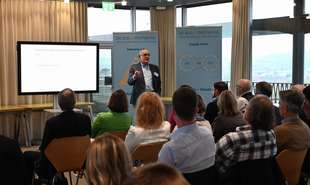
To achieve this, new concepts were needed: streamlining the product range, adjusting quantity planning, and strengthening the trust of retailers in the company, as well as in the now Chinese manufacturer of the devices. Acél & Partner played a crucial role in establishing the new logistics chain from the manufacturer in China to Europe, reorganizing the Europe-wide distribution within six weeks. According to Rutishauser, this would hardly have been possible without a strong personal network both within and outside the company.
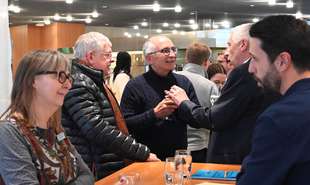
After a final discussion and closing remarks by Professor Konrad Wegener, the participants took the opportunity to exchange ideas and network while enjoying an impressive view of the city of Zurich and the lake.
Lea Tokareff / klk