Logistics should not become increasingly complicated, but rather simpler for the user with the help of artificial intelligence. At least, that is the central theme of the 43rd Dortmund Talks, the so-called "Future Congress" of the Fraunhofer IML, taking place on September 9th and 10th.
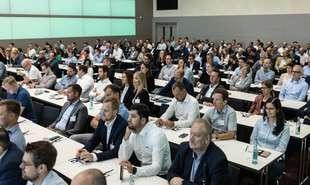
On the first day of the congress, Alice Kirchheim, Director of the Fraunhofer Institute for Material Flow and Logistics, Franz Mathi (Knapp AG), Kerstin Höfle (Körber Supply Chain), and Jakub Piotrowski (Duvenbeck) will give keynote speeches on AI, followed by a panel discussion. Professor Michael Henke (Director of the Fraunhofer Institute for Material Flow and Logistics) will discuss the question "AI through the galaxy – how much logistics does the space economy need?" with, among others, Theresa Gröninger (Bremen Parliament) and Professor Jan Wörner (acatech). The day will conclude with the session "Just do it – making transport logistics future-proof with AI.".
AI through the galaxy
Professor Uwe Clausen (Institute Director Fraunhofer IML) discusses the use of AI in transport logistics with Roland Rüdinger (Rüdinger Spedition), Thomas Pentza (Geis Group), Martin Friedrich (Fraunhofer IML) and Anja Seemann (specialist journalist, moderator).
The first day concludes with the pitches of the finalists for the »Digital Logistics Award«, one of the most highly endowed awards in the logistics start-up scene.
The Fraunhofer Symposium on the second day of the congress, September 10, is divided into three main topics. Under the motto "AI in Motion," experts from Fraunhofer IML will discuss in various sessions how AI can be used effectively in robotics, intralogistics planning, and air transport logistics.

The "AI for Resilient Logistics" section will explore various AI solutions for logistics in different sessions: How can I identify potential within my company using AI? How can I delight customers with intelligent service concepts? The third focus area, "AI for Sustainable Logistics," will center on topics such as sustainable transport chains, increasing sustainability through AI, and sustainable battery logistics. A fourth focus area will present and discuss various research projects developed in collaboration with partner companies and institutions.