The production of meat-free food can be surprisingly energy-intensive, with logistics sometimes accounting for only one percent of the total effort. The focus day on this topic, organized by SVTL and GS1, raised some unexpected questions but ultimately proved to be productive.
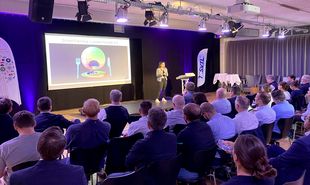
The joint event hosted by the Swiss Association for Temperature-Controlled Logistics and the transport and standardization specialists from GS1 at the "Tanzwerk" in Zurich attracted over 60 participants. From various perspectives, the event explored the distinct paths taken by refrigerated transport in the food and pharmaceutical sectors; whether urban logistics, given the current challenges facing global supply chains, can give new impetus to the marketing of regional products; whether it makes sense to accelerate online deliveries to ten minutes; what levers are available to reduce emissions and conserve valuable resources; whether the much-discussed digitalization truly leads to rapid innovation; and why most online shops have so far only operated at a loss.
Christine Schäfer from the Gottlieb Duttweiler Institute, which is affiliated with Migros, explained that consumer behavior has changed considerably – and this will continue to be the case in the future, with corresponding consequences for logistics and distribution. Climate change will leave a significant footprint on food production as well. Temperature changes and torrential rains have already left their mark. Wine grown in Spain is suddenly extremely sweet due to the high hours of sunshine, while in Scandinavia, a quite good Riesling has recently been thriving.
A "protein revolution" is underway in food production, one that avoids killing animals and instead promotes vegan products and new methods, including "vertical farming" and the plant-based provision of essential nutrients for the human body. This may even extend to AI-supported "menu planning systems" that, based on an analysis of the consumer's digestive "deposits," advise them on which supplements to take to improve their current health status.
This doesn't exactly inspire boundless enthusiasm in GS1 co-organizer Jan Eberle, who points to "increasingly artificial" food products. But at least: the plant-based proteins are ones that already occur in nature.
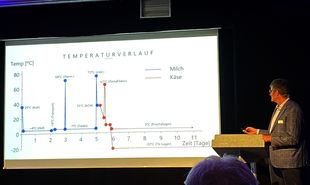
Even new production methods cannot function entirely without water and additional energy expenditure. And as a report on Züger's fresh cheese production later reveals, even temperature-controlled logistics, including warehousing, often only account for a fraction of the total provision costs and associated emissions.
Oliver Schwarz from distribution specialist Voigt Industrie Service explained why the food and pharmaceutical sectors have largely followed separate paths, even though both are concerned with adhering to prescribed temperature limits. The reasons, he said, lie in significantly different regulatory frameworks, which are very strict for pharmaceuticals. However, pharmaceuticals are often considerably more tolerant of temperature fluctuations than many food products, as the well-known sensitivity of bananas demonstrates. Passive cooling is often sufficient, while some suppliers, for safety reasons, now even employ active temperature control in refrigerated vehicles, simultaneously using heat-insulated reusable containers. This, of course, is also a question of cost.
According to Schwarz, a large number of standards and legal requirements are causing ever-increasing costs, while common sense, which is often in higher demand, is being neglected. A proposal by SVTL Managing Director Georg Burkhardt, suggesting that shared transport vehicles could be used to combine routes and freight capacities, given the use of similar temperature-controlled technologies, was somewhat dampened by the reference to differing procedures, marketing channels, and strategies.
Start-ups are still rare in Switzerland, says Professor Jörg Grimm, who teaches industrial engineering at the Bern University of Applied Sciences. After providing an overview of existing initiatives for newcomers, he explains to the audience that he is happy to help them make connections and explore funding opportunities for young people.
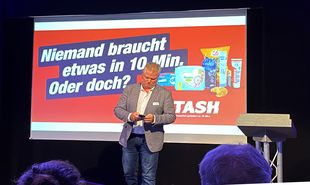
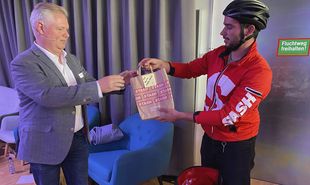
Among the newer ventures is the express courier service "Stash," offering deliveries within ten minutes. It takes the bicycle courier just 90 seconds to sprint to the customer's drop-off point with the desired item after receiving the order. On stage, co-owner and CEO Benno Burkhardt is unfortunately struggling with a missing update to his smartphone app, so—though also quite revealing—the online ordering process ultimately takes longer than the delivery time at the conference venue. Given the short delivery time, maintaining the correct temperature during transport isn't a major issue.
That urban logistics is now successfully connecting with regional food producers and farmers is illustrated by Emilija Damjanovic, on behalf of the Swiss Post, which has now established a model presence in this area, and Felicia Schäfer from a cooperatively organized food network in Basel. Schäfer describes her non-profit network, which covers a radius of 30 km and is still in the development and expansion phase, as "brutally local".
 Photos: klk.
Maike Scherrer from ZHAW, already a familiar face, was present. She, followed by Peter Kuhn, the sustainability officer at Züger Frischkäse, saw confirmation from the company's energy consumption data that logistics often accounts for only a fraction of the CO2 footprint. This was reason enough for the cream cheese manufacturer to generate as much energy as possible on-site through heat recovery, solar energy with 1567 modules, and other measures.
Maike Scherrer's prediction regarding future forms of transport in city logistics is that there will not be just one single solution for sustainable delivery alternatives – a parcel box model from the postal service, bicycle couriers who sometimes manage the volume that a single small delivery van can achieve with a well-planned tour using only seven individual trips, milk boxes or the already familiar bread boxes – but probably more mixed delivery options in the future.
Georg Burkhardt: "So supply chains are becoming more complex and variable – but presumably also more expensive." Many customers are simply not (yet) willing to pay the price for well-thought-out solutions. In a concluding panel discussion, Andrea Krapf from the Migros cooperative in Zurich pointed out that she is not aware of any online shopping option that operates profitably. "We still have a lot to try out.".
Author: Klaus Koch
www.svtl.ch