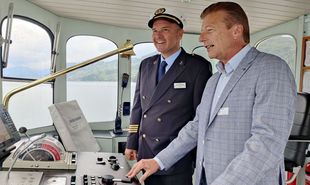
 President Manzetti at the wheel
The Swiss Association for Temperature-Controlled Logistics (SVTL) celebrated its 75th anniversary with an eventful program at the Swiss Museum of Transport in Lucerne and a trip on the paddle steamer "Uri" on Lake Lucerne. Around 50 participants demonstrated their interest in the numerous SVTL activities.
In the auditorium of the Hans-Erni-Museum, President Marco Manzetti and Managing Director Georg Burkhardt reviewed the past year, as well as the "three-quarters of a century" of the association, which was originally founded as an interest group of commercial cold storage facilities.
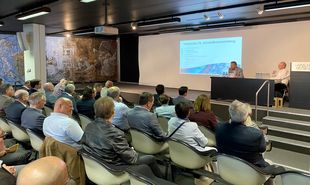 General Meeting at the Hans-Erni-Museum
In fact, Switzerland's first commercial cold storage facility was founded in Geneva in 1927 by the Sociétê des gares Frigorifiques, a subsidiary of the Swiss Federal Railways (SBB), and the Sociétê Française de Transport et Entrepots frigorifique (STEF), a subsidiary of the French State Railways (SNCF). In 1932, a railway station cold storage company was established in Basel at the initiative of the SBB and SNCF. The German Reichsbahn and the Belgian railways also participated. At that time, refrigerated goods were primarily transported by rail. Ice factories were set up in Geneva and Basel to keep the railcars at low temperatures.
After the Second World War, the managing directors of the cold storage facilities in Lucerne and Basel drafted the statutes under which a cold storage association could operate. These culminated in the founding of the association in 1947. President Marco Manzetti notes that nine companies were involved from the outset: from Basel, Bahnhof-Kühlhaus AG; Kühlhaus Genossenschaft Luzern; Brauerei Hürlimann from Zurich; Gefrierhaus AG in St. Margrethen; Sociétê des gares Frigorifiques in Geneva; Sociétê de Entrepots frigorifique Flon in Lausanne; Tiefenbrunnen AG in Zurich; and Kühllagerhaus Seebach and Luchsinger.
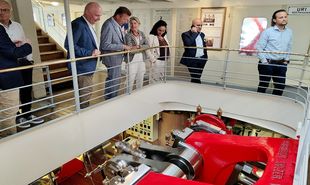 The aircraft of the "Uri". Photos (3): M. Frutig / INOVERIS
The tasks, while not immediately apparent in their full scope, spanned numerous areas. They included warehouse regulations, industry tariffs, occupancy statistics, contractual matters, insurance issues, fire safety, energy costs, and technical equipment such as compressors, evaporators, order picking, sorting systems, and the implementation of guidelines for working in refrigerated environments. A major topic, according to Manzetti, was always the choice of refrigerant. They advocated for ammonia (NH3 or R717), "one of the few refrigerants that is climate-neutral," as it neither damages the ozone layer nor contributes to the greenhouse effect. The reliability of the refrigeration systems is of paramount importance. "In some warehouses, goods worth up to 100 million Swiss francs can quickly accumulate," Manzetti explained. "In such cases, there's no point in even turning the key in the lock if the machines fail."
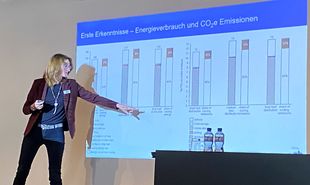 Furious: M. Scherrer. Photo: Koch
The groundwork laid by Manzetti's predecessor, Helmut Senn, has borne fruit. More recently, cooperation with other industry and logistics associations has strengthened, and the constructive work of the first full-time managing director, Peter Rupper, over many years, as well as the current work of Georg Burkhardt, has proven extremely successful. Participation in the logistics market study, events such as the thematic focus day at GS1, and the focus on Logistics 4.0 in the temperature-controlled food supply chain have been considered exceptionally effective. Manzetti: "We are a small association that achieves great things with limited resources.".
Georg Burkhardt points to upcoming priorities in urban logistics, a current ZHAW project focusing on energy-autonomous logistics cold chains, and on September 8th, another focus day on the topic of "Cold Chain in Transition".
A dynamic and highly knowledgeable presentation by Maike Scherrer from the School of Engineering (research focus: Sustainable Supply Chain Management and Mobility) on the development of a simulation model for addressing energy consumption and CO2 emissions was a welcome addition to the event. The project, supported by Züger, Aryzta, Ralog, stisa, Clemap, CarbonCare, Schwab-Guillod, and the SVTL, is scheduled for completion in 2025.
 Passing right by the sister ship
Initial findings should provide insights into the various phases of energy consumption. According to these findings, cold storage facilities would account for only about 1 percent of the energy demand, transport from the producer to the logistics distributor for 25 percent, and subsequent distribution to the point of sale for approximately 74 percent. The simulation model is designed to incorporate the impact of the choice of refrigerant, the use of alternative drive systems (electric and/or fuel cells for transport and refrigeration), multimodal transport methods, and other variables into an algorithm that serves as the basis for calculating the overall energy load. The ultimate goal, according to Scherrer, is a supply chain certificate.
In cooperation with supporting members from the planning and cold storage/deep-freeze warehouse construction sectors, will the development of sustainable and energy-autonomous buildings
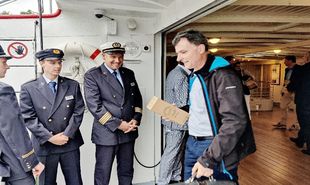
the Raphael Pfarrer and Allan Nicholas from AWK addressed
The subsequent tripon the paddle steamer "Uri" was very well received – as was a rich buffet, which was enjoyed in the surroundings of historical and authentic wooden paneling on board the ship built in 1901.
www.svtl.ch