30 percent above pre-crisis levels
 Photo: Swissmem
In the Swiss machinery, electrical, and metal industries, order intake grew by just over ten percent compared to the same period last year, sales by twelve percent, and exports by nine percent. Nevertheless, according to Swissmem, there is little reason for excessive celebration.
Because significant risks remain. Supply chain problems and massively rising energy and raw material prices have, in some cases, considerably increased production costs. The rapid nominal depreciation of the euro is putting additional strain on companies. All of this is squeezing company margins. Furthermore, there is a risk of energy shortages next winter. This must be prevented. In industry, supply interruptions of electricity and gas would jeopardize companies and their jobs.
the order volume of the Swiss MEM (mechanical, electrical, and metalworking) industry is now 30 percent higher than the pre-crisis level in the fourth quarter of 2019. However, growth momentum slowed in the second quarter of 2022. A similar picture emerges with regard to sales, which increased by 12.1 percent compared to the first half of 2021. Due to the high order backlog, sales are expected to continue to rise in the second half of the year. Both SMEs and large companies are benefiting from this positive business development.
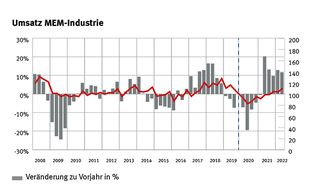 Graphic: Swissmem
Capacity utilization in companies reached a high 90.3 percent in the second quarter of 2022. In the first quarter of 2022, 320,900 people worked in the MEM sector. Furthermore, the number of job vacancies in Swissmem member companies increased by 32 percent within a year.
Dark clouds
Swissmem Director Stefan Brupbacher: “The order and sales development in our industry is encouraging. However, that’s only half the story. Supply problems and, above all, the sharply rising energy and raw material prices have significantly increased production costs. By no means all companies can quickly pass these higher costs on to their customers. In particular, the exploding energy costs are threatening the very existence of some companies.”
For the next twelve months, 30 percent of businesses expect a decline in orders from abroad. The proportion of those anticipating higher orders has decreased from 35 percent to 29 percent. The level of the Purchasing Managers' Index (PMI) for the manufacturing sector reflects this downturn. In the Eurozone, the most important market for Swiss industry, the PMI fell below the growth threshold in July 2022 for the first time since mid-2020.
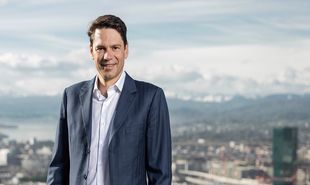 S. Brupbacher. Photo: Private
Industry is existentially dependent on an uninterrupted energy supply for its production processes. Only some MEM (mechanical, electrical, and metalworking) companies are able to compensate for potential interruptions through flexible production planning. However, companies whose production processes require high temperatures are absolutely reliant on an uninterrupted supply. If this supply were to fail, they would have to completely cease production. Martin Hirzel, President of Swissmem, warns: "A shortage of electricity or gas must be prevented at all costs. It would jeopardize industrial companies and their jobs." Therefore, industrial companies that are technically dependent on an uninterrupted energy supply must be exempt from any potential gas/electricity rationing.
It is encouraging that the federal government is already working to develop significant reserve capacity for electricity production for this winter. However, this alone will not be sufficient. There must be no bans on specific technologies. The Energy Strategy 2050 needs to be adapted. The current situation clearly shows that it is not possible to phase out both nuclear and fossil fuels simultaneously. The federal government's intention to build two to three gas-fired power plants with a total capacity of up to 1,000 megawatts by 2025 is a step in the right direction. Furthermore, the permitting processes need to be streamlined. Swissmem President Martin Hirzel demands: "The 15 hydropower projects defined by the Round Table last December must be implemented as quickly as possible. Switzerland can no longer afford years of delays in power plant projects." With a draft law that restricts the possibilities for objections to these projects and streamlines the procedures, the people could vote on it in a referendum as early as the end of 2023.
LI-NEWSLETTER
Every week, the latest logistics news from Switzerland, the EU and the rest of the world.
Subscribe now