Hyperloop capsule certified
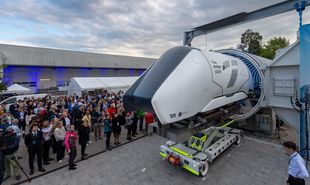

At the Technical University of Munich, the first Hyperloop capsule – not for freight transport, but for the even more safety-critical passenger transport – has been certified on a 24-meter track. Now the researchers want to focus on the propulsion system, the levitation technology, and the vacuum behavior.
Numerous models have already been built – now the Technical University of Munich speaks of “Europe’s first full-size Hyperloop test track”.
The test segment at the Ottobrunn campus, with its relatively short 24-meter test tube, has gone into operation after less than a year of construction. In the future, people will be transported from point A to point B at speeds exceeding 800 kilometers per hour.
Founded in 2020 as a student initiative, the TUM Hyperloop research group has since been working on the new, low-emission and, above all, fast way of traveling.
Photos: TUM
The 24-meter-long test track, in the form of a concrete vacuum tube, a passenger capsule, and the subsystems necessary for operation are now ready for practical research. "The transition from model scale to real dimensions, and especially Europe's first passenger test under vacuum conditions, is an important milestone for scaling up the technology soon and realizing longer test segments"explains Gabriele Semino, project manager at TUM Hyperloop.
Researchers have already proven that the TUM Hyperloop test segment is fully functional during an initial test run. The maiden voyage with a passenger capsule took place on July 10th within the vacuum of the test tube. To enable operation with passengers, the demonstrator was certified for passenger use by TÜV Süd.
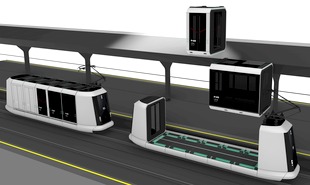
The TUM Hyperloop demonstrator consists of three elements. The most obvious part is the 24-meter-long concrete tube. It has a diameter of 4 meters and, in addition to a platform, houses components of the technology necessary for levitation and propulsion of the passenger capsule. The capsule has a fully equipped interior designed to provide a comfortable journey for up to five passengers. The passenger module is optimized for use in a vacuum. The third part of the system is the operations control center, which, besides controlling the demonstrator, also houses components such as the high-performance vacuum pumps. "With our system, we can specifically investigate the propulsion system, the levitation technology, the capsule's behavior in a vacuum, and safety aspects on a fully functional Hyperloop segment"says project manager Semino.
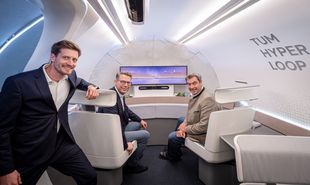 Passenger cabin with Prime Minister
Bavarian Minister-President Markus Söder, speaking at the opening, said: "Great respect for this spirit! Young students have developed an inspiring idea into a powerful statement for engineering and the future"Bavaria is investing over five billion euros in research and technology as part of its high-tech agenda. In addition to the Hyperloop test track, "Europe's largest aerospace faculty". Söder added: "The future is being made here. "
Bavaria's Science Minister Markus Blume emphasizes that the Hyperloop is based on a student initiative. "Today, the project is a unique research endeavor and part of the high-tech agenda. With a passion for the future and technology, young talents are turning science fiction into reality and setting real standards"The TUM Hyperloop team has – almost asan aside– not only built the test track but has also won Elon Musk's Hyperloop competition four times.
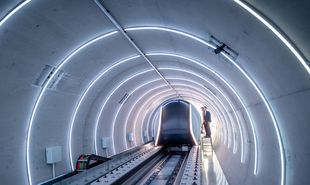
Since 2015, TUM has been working on the vision of making mobility sustainable and, above all, significantly faster than before. The initiative, initially a student project, was founded to participate in the SpaceX Hyperloop Pod competitions, launched by Elon Musk and his space company. The TUM team took first place in all four competitions. Encouraged by these successes, the student project evolved into the current TUM Hyperloop research group.
TERMS FROM THE LI GLOSSARY
dimensionLI-NEWSLETTER
Every week, the latest logistics news from Switzerland, the EU and the rest of the world.
Subscribe now