Formula 1 for logistics
 Talk show with Rosberg
Former Formula 1 driver Nico Rosberg appeared at the German Logistics Congress at exactly the right time to compare his former rivalry with Lewis Hamilton with the events in the transport industry – and to recognize when it is necessary to pull together on overarching issues.
With the energy transition, the coronavirus crisis, the disruption of essential supply chains, and the war in Ukraine, the logistics industry currently finds itself in the eye of a hurricane, the effects and remnants of which are not so easy to manage. Ultimately, numerous individual problems, including innovative and long-standing pressing issues such as emissions, all need to be addressed simultaneously.
 Steel made from hydrogen and CO2?
Thomas Wimmer, CEO of the German Logistics (BVL), cited several approaches to the resulting activities at the opening of the industry gathering, which was attended by more than 2,000 people. These included measures to combat bottlenecks in supply chains, which should no longer rely on single sources or, as in the case of China with silicon and rare earths from Russia, on monopolysuppliers, but rather on "multiple sourcing." He stated that digital potential could be effectively leveraged with companies like Siemens, which explicitly offer to "bring together the real and virtual worlds"(Although Siemens itself, with its approximately 300,000 employees, cannot deny its own CO2 production of 10 million tons at the same time.)
The Swedish steel manufacturer SMS, explains Katja Wind, member of the management board and BVL board member, is working on a steel plant with a projected total cost of €5.5 billion. This plant will be powered entirely by hydrogen and, using CO2, will produce the expensive material for the automotive industry without any additional emissions. After all, steel production contributes 0.7 percent to global economic output – but ten times that amount to global emissions.
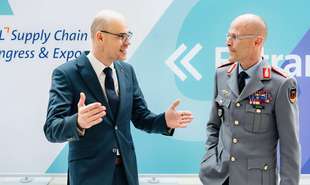
 In the eye of the hurricane. Photos: klk
One of the projects nominated for the German Logistics Prize is thanks to a university hospital (Mannheim) located in a so-called "brownfield", i.e., in "traditional structures" , where a fundamental modernization of intralogistics, material and drug supply could be implemented using AI and a digitalization concept.
And with regard to the “big chunks” , Hapag Lloyd has recently been able to facilitate the shipping of heavy goods through automated handling and loading procedures – and also aims to reduce a wide range of emissions to a lower level as a result.
So there is much to do for an economic sector that has so far had to describe itself as " extremely conservative " – primarily due to its high traffic volume and the large proportion of conventionally and fossil-fueled transport systems
Someone like Nico Rosberg is just the right person to make sustainability and electric mobility "a little cool"as he himself puts it. Incidentally, as reported, he's also now a "brand ambassador" for forklift manufacturer Jungheinrich.
 Logistics – a construction site initself.
Cloud4Log, a collaborative project between BVL and GS1 Germany to digitally accelerate the handling of electronic waybills and replace previously cumbersome paper documents, is seen here as a model.
Christa Koenen, Head of Digital at Schenker, also takes this opportunity to promote the Open Logistics Foundation, which, instead of the usual competition between logistics companies, relies on the catalytic effect of common standards for data exchange . After all, Malcolm McLean once made the basic principle of the container as a transport unit openly available worldwide. As if by chance, she thus draws a connection to Nico Rosberg. The now 37-year-old speaks of the fierce competition – even within the Mercedes racing team, where he battled Lewis Hamilton for valuable titles. "Even our mechanics were practically enemies at one point and stopped speaking to each other"But when it came down to beating Ferrari in a final round, everyone suddenly worked together again. Rosberg: "It was like a shock"After all, every detail matters, even during a tire change. The driver's life depends on everything running smoothly. When it came to the ultimate goal, everyone pulled together again. As a result, he "never even saw Ferrari in his rearview mirror anymore".
Whether the German economy – especially the logistics sector – can distinguish itself with Formula 1-like qualities when it comes to issues of sustainability, energy transition, digitalization, and electromobility, Rosberg answers with a typical racing driver analogy. "We need to shift gears faster"he says.
TERMS FROM THE LI GLOSSARY
CO2 compensation certificatelogisticssuppliersIn-house logisticsJungheinrichData exchangeLI-NEWSLETTER
Every week, the latest logistics news from Switzerland, the EU and the rest of the world.
Subscribe nowYou might also be interested in this