No more going it alone

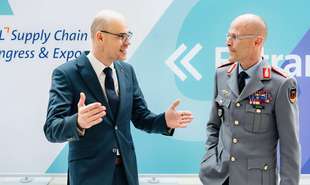
At the opening of the LogisticsFuture Congress in Dortmund, Michael ten Hompel, head of the Fraunhofer IML, quoted SchenkerCEO Jochen Thewes: "Once you understand what it's all about, it's strikingly simple. Every company can sink millions into digitalization on its own. But you can also move forward together."
The so-called "Silicon Economy" and, with it, the "Open Logistics Foundation" still require some explanation. Meanwhile, even more neologisms and monstrosities like the "Silicon Economy Continuum" are emerging, which could easily confuse, if not discourage, those not yet fully convinced of the benefits of digitalization. The Fraunhofer researchers, however, have stated their intention to bring "everyone" along.

At the opening of the renowned "Future Congress" of Logistics in Dortmund, organizers and promoters once again find themselves compelled to explain the nature of these new "spheres of activity." While some are already venturing into entirely new realms, others are still preoccupied with simply transporting goods and deliveries from point A to point B. Explaining that and how these two aspects are interconnected will likely require considerable effort.
Be that as it may, for Fraunhofer researchers, "100% digitalization" is no longer just a vision, but a space, a kind of "Dorado," the logistics equivalent of "Silicon Valley" with common standards and interfaces, where software and an open-source repository accessible to everyone offer a wealth of potential. It's a toolbox that anyone can access, and whose components—mostly software—can be installed in their own company as a communication interface. "Of course, many things like track and trace are already well-known," says ten Hompel, "and for some, it's almost unnecessary to mention them. But as open source, and used to drive further development from a common starting point, it takes on a new dimension." "If you're founding a company or launching a start-up, then use these resources!" This provides the necessary "springboard" to jointly apply existing technologies and build upon them for further development.
 J. Thewes
Once again, a whole kaleidoscope of innovations is taking place at the Fraunhofer-IML, ranging from the two-wheeled, Segway-like but gripper-equipped evoBOT to the all-wheel drive pallet robot "Odyn" and laser projections that will "in the future also show paths and positions in the warehouse without glasses".
“Let’s build a powerful ‘community’,” the IML chief promotes the major project of the Open Logistics Foundation and the open “repository” platform, “to move things forward together with our US and Chinese friends.”.
In fact, says ten Hompel, referring to a product announcement by Elon Musk at the end of September, the trend, which at times focused more on pure functionality, is already moving back towards the humanoid design of robotic helpers.
Digitalization and data systems are also indispensable for Oliver Luksic, the German Federal Government's Commissioner for Freight Transport and Logistics, as he states in his greeting.
 Odyn
Steffen Bersch, CEO of ssI Schäfer and, for some time now, chairman of the Intralogistics and Materials Handling within the VDMA (German Engineering Federation), sees warehouse technology and distribution centers as essential building blocks in the supply chain. A "minor problem we are currently experiencing" is indeed the shortage of skilled workers. Connectivity and the degree of automation are key to solving this. However, new "pain points" and new questions are also emerging. AI methods are necessary to even begin to grasp and manage these in all their complexity. The Open Logistics Foundation, with its open platform, is exactly the right place to move forward. Bersch: "The warehouse is not a closed microcosm, but a pivotal point." The Open Logistics Foundation is a kind of "unified commerce" platform from production to the point of sale, which could play a prominent role in Europe.
 MtHompel, St.Bersch, R.Düster (from left to right)
Ralf Düster, CEO of the software provider Setlog, responds to the question of whether company leaders are risking everything by using open source: "Easier data exchange allows us to arrive at current solutions faster. We have to take advantage of this – and not get bogged down in the basics forever. There are still too many people working with manually filled-out Excel spreadsheets and billions of emails being sent back and forth without actually exchanging data intelligently." Bersch's direct question to the participants about how openly, for example, ssI Schäfer uses open source elements requires some consideration. "Of course, you have to consider your own unique selling points within your company. These need to be clearly defined. (...) But on this basis, you can take action and thus make faster progress."

On the second and third days of the congress, the Fraunhofer Symposium will take place, featuring themed sessions on the future of logistics. Experts will discuss topics such as the digitalization of load carriers, data-driven optimization of intralogistics, quiet logistics in cities and ports, and the possibilities of co-creation using digital platforms. Furthermore, on all three days of the congress, scientists from the Fraunhofer IML will present their latest research developments directly from their research in the "Digital Sandbox.".
www.zukunftskongress-logistik.de
LI-NEWSLETTER
Every week, the latest logistics news from Switzerland, the EU and the rest of the world.
Subscribe nowYou might also be interested in this