Virtual refrigerated truck
A fully loaded refrigerated truck is a complex system: cool air must circulate between tightly stacked boxes and pallets. How well this works depends on the airflow velocity, the packaging , and the pallet arrangement. Empa has studied the temperature measurements.
 Photos: EMPA
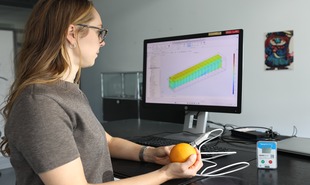
Often, temperature is monitored by only a single sensor. Insufficiently pre-cooled pallets, unsuitable packaging, or improper stacking create hot spots. Empa researchers have developed a digital twin of a refrigerated truck to optimize transport and better assess food shelf life.
Better assessment
"Our digital twin simulates air circulation and heat transfer throughout the entire cargo space. This allows us to estimate the temperatures at different points within the cargo area."
Using a physics-based model of a refrigerated truck loaded with oranges and lemons, the researchers simulated how the cooling air flows through the different packaging and how heat is transferred between the air and the fruit. The model also takes into account the temperatures of the fruit at the start of the journey and the small amount of heat they generate themselves through respiration.
To test the digital twin of the refrigerated truck, the researchers fed it real-world data on the load, initial temperatures, and the cooling air during transport. A commercial transport from Nafplio, Greece, to Pratteln, Switzerland, served as the test case. The 31 pallets of oranges and lemons were pre-chilled for approximately 24 hours and then transported for four days at a temperature of four to six degrees Celsius.
From Nafplio to Pratteln
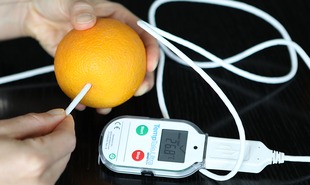
The researchers then compared the temperatures calculated by the digital twin with the actual measurement data. A total of 108 sensors were placed at different points on the fruit during packaging. 97 recorded the fruit temperatures, while the others measured, among other things, the ambient air temperature and the intake and exhaust air from the cooling unit. "This was a challenging test for the digital twin," says Tobler. "The fruit wasn't all cooled down uniformly at the start, and oranges and lemons were in different packages. Nevertheless, the model was able to accurately reproduce the most important temperature developments at most points."
 E. Tobler
The measurements also revealed some discrepancies. During transport, oranges in the middle of the truck warmed up more than predicted by the Empa model: their temperature rose from around 7.7 to as high as 10.8 degrees Celsius, even though the cooling air was significantly colder. "We suspected that, in addition to the affected, monitored pallets, there were insufficiently pre-cooled pallets that were not equipped with sensors," explains Tobler.
In a second calculation, the researchers therefore increased their assumed initial temperature from around 5.4 to 10 degrees Celsius. The simulated temperature development then corresponded much better with the actual measurements. "In the simulation, we were able to trace how the heat was transferred from one pallet to the next and transported further by the airflow. This supported our hypothesis," says the Empa researcher.
Furthermore, it became clear that a truck's refrigeration system has only a limited capacity to subsequently cool already warm fruit inside a densely loaded pallet. Refrigeration units are primarily designed to maintain the temperature of pre-chilled goods.
Circulation under scrutiny
Packaging also plays a crucial role. In the transport examined, the lemon crates had ventilation openings on several sides, while the short sides of the orange cartons were closed. "With packaging, it's not just about how it looks or how sturdy it is," says Tobler. "It also has to allow cool air to reach the goods. It's equally important that the pallets are evenly aligned and that the openings aren't blocked by neighboring cartons."
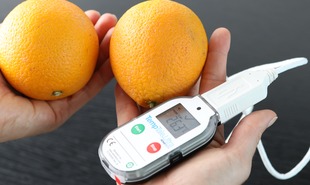
The digital twin could initially be used as a simulation tool. Logistics companies and manufacturers could use it, for example, to investigate how new packaging, a changed pallet arrangement, or air circulation affects temperature distribution. According to Elisabeth Tobler, companies with standardized transports that regularly use the same trucks, packaging, and loading patterns would particularly benefit.
In the future, the model should also complement monitoring systems. For this purpose, it will be linked to real sensor data from an ongoing transport. The sensor provides the link to reality, while the model derives the conditions throughout the entire cargo space from this data. "Much of the necessary data is already being collected. The crucial thing is to bring it together and use it in the right place and at the right time," says Tobler.
Improve planning
This would allow importers to identify, even before a shipment arrives , which pallets have been exposed to higher temperatures and should be inspected more closely. Goods with a shorter shelf life could then be made available for sale earlier. "In the long term, the goal is data-driven monitoring of the supply chain ," adds Empa researcher Thijs Defraeye. "The digital twin should not only display temperatures but also help companies to manage their transport and handling of incoming goods more effectively, thereby reducing food waste."
A recent SRF program in the science magazine " Einstein " showed how " food waste " can be reduced with simple means.
www.empa.ch
LI-NEWSLETTER
Every week, the latest logistics news from Switzerland, the EU and the rest of the world.
Subscribe now