USA: Where German intralogistics providers are growing
Despite strained transatlantic relations, North America is becoming the most important growth market for German intralogistics providers. SAFELOG, SYNAOS, Wiferion, and PSI Software describe what is different about the US market and what is important there.
 Intralogistics has become a booming industry in the USA. (Image source: Pixabay – TungArt7)
FACTS
- Pursue
- SAFELOG, SYNAOS, Wiferion (PULS), PSI Software
- Location
- USA
- Theme
- US strategies of German intralogistics providers
- In numbers
- US warehouse automation: approximately US$15 billion by 2030
The market figures are impressive: Warehouse automation in the US is growing at a double-digit rate every year and could reach a volume of around 15 billion US dollars by the end of the decade. Logistics software and warehouse robotics are developing with similar dynamism. The following four assessments show how German technology providers are approaching this market, what unique aspects they are experiencing in sales, and why the US is becoming a crucial growth driver for them.
SAFELOG: Robustness counts more than high-tech
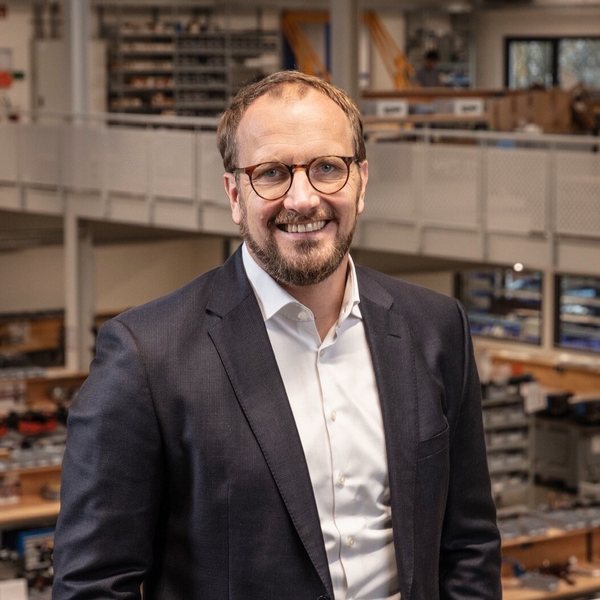 Mathias Behounek, Managing Director of SAFELOG GmbH. (Image source: SAFELOG)
For Mathias Behounek, CEO of SAFELOG, the US market has moved beyond the initial pilot project phase. Now the focus is on rapidly expanding robot fleets. Technical sophistication is less important: what's needed are systems that operate reliably in three shifts and quickly pay for themselves.
According to Behounek, the challenges are similar on both sides of the Atlantic: a shortage of skilled workers, cost pressures, and increasing performance demands. The difference lies in the perspective. While German customers focus on technical details, US companies place even greater emphasis on rapidly measurable results, quick implementation, and scalability. Robust systems with predictable costs benefit from this.
“We have always pursued the approach of solving every task with as little technical complexity as necessary. This reduces potential sources of error and increases fleet availability.”
The company benefits from its partnerships. Through TGW and SEW-Eurodrive, SAFELOG gains access to major automation projects of international corporations. The long-standing collaboration with Mercedes-Benz, where over 3,000 SAFELOG robots are in operation worldwide, further builds trust in the US market. TÜV SÜD has already certified the S3, M4, and L2 product families according to UL standards for the USA and Canada, and the GT1 and XS1 models are currently undergoing certification. Due to unpredictable trade policies, SAFELOG is also exploring the possibility of establishing its own production facility in the USA to shorten supply chains and be closer to its customers.
SYNAOS: A German standard for mixed fleets
 Dr. Philipp Schäfers, Head of Partner Management & Business Development at SYNAOS. (Image source: SYNAOS / Frederike Wetzels)
Reshoring, investment programs, and a shortage of skilled workers are currently driving the rapid development of new factories in the US. According to Dr. Philipp Schäfers of SYNAOS, automation is not an option for the future, but rather a prerequisite for bringing these factories online. Consequently, decisions are made pragmatically: pilot, evaluation, rollout – often within months instead of years.
This pace has a downside. Companies that automate quickly tend to buy whatever vehicles are readily available. This leads to mixed fleets from different manufacturers, each with its own control system, resulting in a patchwork of isolated solutions by the second or third plant. Adding to the complexity this summer is regulation: the US Federal Communications Commission (FCC) has placed foreign-made mobile robots on its "covered list." Which vehicles are allowed into US plants now depends more heavily on regulatory decisions. Companies that use an open standard to separate the control system from the vehicle can switch or add manufacturers without rebuilding the entire process logic.
This standard is provided by the VDA 5050. Developed by the VDA and VDMA, it is manufacturer-independent, written in English, openly developed on GitHub, and free of charge. According to Schäfers, it is rapidly gaining importance in North America, thanks in part to European examples such as the VW plant in Bratislava, where 89 automated guided vehicles (AGVs) from various manufacturers operate on a common platform. With the ISO 21423 standard published in October, cross-manufacturer interoperability also gains an international foundation. The US automation association A3 explicitly cites VDA 5050 as one of its base standards. Interoperability is thus evolving from a technical issue to a purchasing criterion.
Crucially, the orchestration layer above it integrates vehicles from different manufacturers, manual transport, and processes into a single system. According to SYNAOS, they manage mixed fleets at plants in the Midwest and South of the USA, sometimes across multiple locations of the same customer. Some plants are already planning with several hundred vehicles, and new production lines are designed from the outset around manufacturer-neutral orchestration (see also "Synaos: VDA 5050 ready for the US market").
"Open standards and vendor-neutral orchestration are not an IT detail, but a strategic decision – between one scalable system and a dozen isolated solutions."
Wiferion and PULS: A good product alone is not enough
 Matt Biskner, President of Puls, LP (Image source: Puls, LP)
 Matthieu Ebert, Director of Product & Technology at Wiferion – a PULS brand. (Image source: Wiferion – a PULS brand)
Matt Biskner, President of Puls, LP, and Matthieu Ebert, Director of Product & Technology at Wiferion, experience the US market as operating on a different rhythm. A few very large companies set the standards and thus also determine how quickly new technologies like inductive charging spread in intralogistics. Wiferion offers wireless charging systems for mobile robots that charge during short stops while the robot is in operation. This saves charging space, reduces downtime, and allows for smaller fleets.
Whether such a technology prevails in the US is determined by the "few giants" logic: those approved as suppliers by the few large players grow rapidly. Those left out struggle because there are fewer medium-sized companies through which the market could be gradually accessed. Once the large players have decided on a technology, they roll it out quickly and in large quantities. They expect the same commitment from their suppliers : reliable delivery capacity and service, rapidly scalable processes, and strict compliance with local regulations. Those considered a risk or entering the US market without their own presence are at a disadvantage. Thanks to its affiliation with PULS GmbH, Wiferion was able to rely on a well-established US organization from the outset.
According to Biskner and Ebert, the "Designed in Germany" label, especially for hardware, continues to be a promise of quality, guaranteeing attention to detail, repeatability, and reliability, and opens doors in the USA. Ultimately, however, what matters is whether a supplier can deliver as quickly and reliably as an American one.
PSI: The WMS as an efficiency driver
 Rüdiger Stauch, Senior Vice President Business Development & Sales, PSI Software SE – Business Unit Logistics. (Image source: PSI Software SE)
The market for warehouse management systems (WMS) is also benefiting from the boom. According to an analysis by SNS Insider, it is expected to grow in the US from $1.5 billion in 2025 to around $7 billion in 2035. The drivers are e-commerce and the shortage of skilled workers, which are forcing American companies to rapidly digitize and automate their warehouse processes, as Rüdiger Stauch of PSI Software explains.
What's striking is how quickly investments are made and implemented in the USA. This is particularly noticeable at the Modex intralogistics trade fair in Atlanta: the exhibition stands are rather down-to-earth compared to LogiMAT, but the discussions are highly professional, solution-oriented, and geared towards rapid implementation.
According to Stauch, the demand is for standardized, cloud-based WMS that can be up and running within a few weeks, ideally as Software as a Service (SaaS) without requiring the customer's own IT infrastructure. This is where PSI's PSIwms GO Retail comes in, combining configurable standard software with proven best-practice processes. Furthermore, US logistics companies are specifically requesting AI-powered functions, such as for picking strategies, demand forecasting, and warehouse allocation. Those who include such modules directly in their standard WMS have a clear competitive advantage. One example is Batch AI, which optimizes picking strategies based on data and delivers rapidly measurable results in clearly defined areas.
This article is based on assessments from the four companies, compiled by the communications agency additiv.
TERMS FROM THE LI GLOSSARY
In-house logisticsSafelogCEOScalability (logistics system)fleetTGW SystemsLI-NEWSLETTER
Every week, the latest logistics news from Switzerland, the EU and the rest of the world.
Subscribe now