Brecht relieves employees
A sensory experience for visitors – demanding manual labor with heavy weights for the employees. At the organic spice supplier Brecht, cardboard boxes have to be lifted, sacks opened, and the exoskeleton "Mate UTB"from Schmalz.
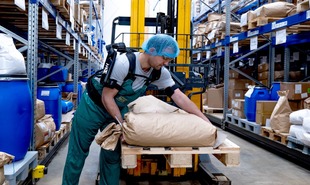
Amidst the scent of pepper and sacks of herbs, the employees at the spice mill lift tons of ingredients daily, repeating the movement hundreds of times. The tasks may seem unspectacular, but they demand a great deal from the body, as several tons have to be moved day after day
Careful processing
Company founder Eduard A. Brecht laid the foundation in 1925, and since the 1930s, the business has focused on organically grown ingredients. Today, the spice mill is part of the Albert Darboven Holding and employs 34 people in Eggenstein-Leopoldshafen near Karlsruhe, producing herbs and spice blends for retailers and consumers. The product range comprises several hundred items. Organic quality, sustainability, comprehensive social standards, and meticulous processing define the company philosophy.
 Photos: Schmalz/A1
Increased productivity: In daily production, employees lift around 50 sacks and cardboard boxes weighing up to 30 kg per shift. In addition, they handle plastic drums with capacities of 60 or 120 liters. The mixing processes also demand strength and stamina. Several hundred times a day, employees move hand shovels weighing up to 3 kg to remove ingredients from the containers, sift the spices, and then transfer them into larger containers.
Relieve joint muscles
Repetitive heavy labor can lead to wear and tear on the musculoskeletal system. Brecht recorded an average of five days of sick leave per quarter due to musculoskeletal disorders. Operations Manager Dominik Bittmann was no longer willing to accept this situation and sought a solution.
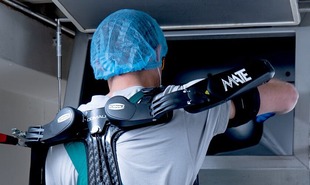
With the "Mate UTB," Schmalz offers an upper-body exoskeleton for activities involving raised arms and repetitive movements. This body-worn assistive system provides purely mechanical support for muscles and joints. It requires no external power source such as batteries or compressed air. The exoskeleton absorbs the force when the arms are lowered and releases it when they are raised. Therefore, the device is extremely lightweight and does not restrict freedom of movement .
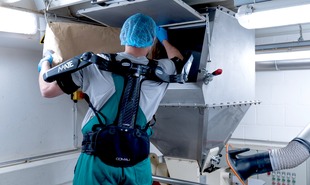
The design combines a stable carbon fiber structure with textile elements. This makes the exoskeleton comfortable to wear and promotes an ergonomic posture. It adapts individually to body type and work style, providing support precisely where movement, strength , and ergonomics converge. Fabric components such as straps and padding are removable and washable, facilitating hygienic use in food production.
The employees of the spice mill were able to extensively test the exoskeleton during an on-site visit to Schmalz. "The before-and-after difference immediately impressed my colleagues"recalls Dominik Bittmann.
Performance improved
The effects are now clearly visible in daily production. The number of lifting operations for sacks and cardboard boxes per eight-hour shift increased from 50 to 60. For shoveling, the number rose from 700 to 800 in the same period. At the same time, the duration of individual lifting operations decreased . For cardboard boxes and sacks, the time dropped from three to two seconds, and for shovels, from two to one second.
The error rate is the point where the quality improvement for Brecht becomes particularly clear: Previously, there were an average of 30 incorrect lifting operations per shift; today, this number is zero. In spice production, the burden no longer rests solely on the shoulders of the employees.
LI-NEWSLETTER
Every week, the latest logistics news from Switzerland, the EU and the rest of the world.
Subscribe now