AGVs at Nestlé are highly flexible
 Smoothed flow of goods
At the Nestlé Nutrition plant in Biessenhofen, 650 employees produce numerous products. With the help of Still, internal transport was automated using Automated Guided Vehicles (AGVs), and six packaging warehouses were consolidated into shuttle channel storage systems.
The result of automation is a continuous transport system for supplying and disposing of materials in production. This has smoothed the flow of goods and reduced inventory levels at the machines. A particular challenge was the need to reorganize the intralogistics while production continued uninterrupted.
 AGV with sauce(s)
The products include hypoallergenic infant formula, oral and tube feeding formulas for hospitals, and the well-known Thomy products. To optimally implement the reorganization of intralogistics, the first step was an inventory. This involved digitizing and analyzing the affected halls, including the new building, as well as all relevant goods and processes. Nestlé Project Manager Eilert Klatt explains: "With this 'brownfield' project, we had to plan and implement all processes (unlike a 'greenfield' project) within the existing structures of our site, which has grown over more than 100 years.".
For the AGVs, the uneven floor levels in the halls were painstakingly leveled, and in some cases, new pathways were created. Thanks to close planning and coordination with Still, as well as the on-time delivery of all 40 components, the automation of internal transport and the pallet shuttle channel storage system were commissioned almost seamlessly and on schedule, while operations continued uninterrupted. During the phased installation, production was supplied manually using forklifts.
 Photos: Knehr
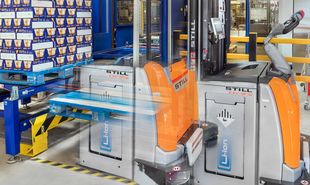
Due to the narrow aisles, four automated high-lift pallet trucks are used. The EXV iGo systems are precise, high-performance warehouse trucks designed for continuous industrial operation and have already proven themselves in numerous automation projects. Another advantage of the EXV, it is said, is its cost-effectiveness. The additional installation of three empty pallet magazines and fire doors completes the new organization of automated internal transport.
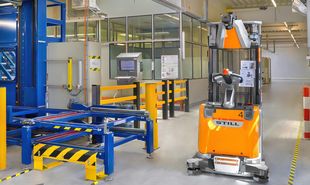
At the transfer station of the roller conveyor, Still AGVs take over the 55 pallets. Equipped with a 360° laser scanner, they reliably navigate the sometimes narrow and winding aisles. Eilert Klatt emphasizes: "AGVs, pedestrians, and forklifts can now also utilize the network of walkways. A rigid conveyor system would only obstruct the narrow aisles unnecessarily." With AGV transport, 60 of the production lines are now supplied more flexibly and continuously, 24/7. Production has thus been converted from a push to a pull principle . Areas previously occupied by stockpiled goods in front of the lines have been freed up, and the flow of goods along the lines has been smoothed.
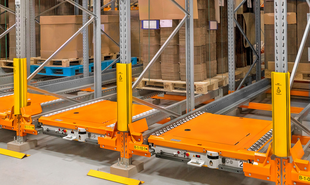 Shuttle in the canal storage
The tasks of the AGVs are diverse. On the one hand, they transport raw materials and packaging to production. On the other hand, the automated EXV high-lift trucks handle waste disposal and empty pallet delivery. Still project manager Thomas Rothbauer explains: “When production reports a need in the SAP host system, a transport order is triggered in the roller conveyor system ‘in the warehouse.’ The conveyors’ inductive sensors control the AGVs. Prioritization allows an AGV to recognize which roller conveyor needs to be served first.” The Nestlé project manager summarizes: “Keep it simple: Still’s automated system is self-regulating. There is no interface to the Nestlé host system, meaning we don’t have to worry about the transport system, because it organizes itself without Nestlé’s complex IT infrastructure.”
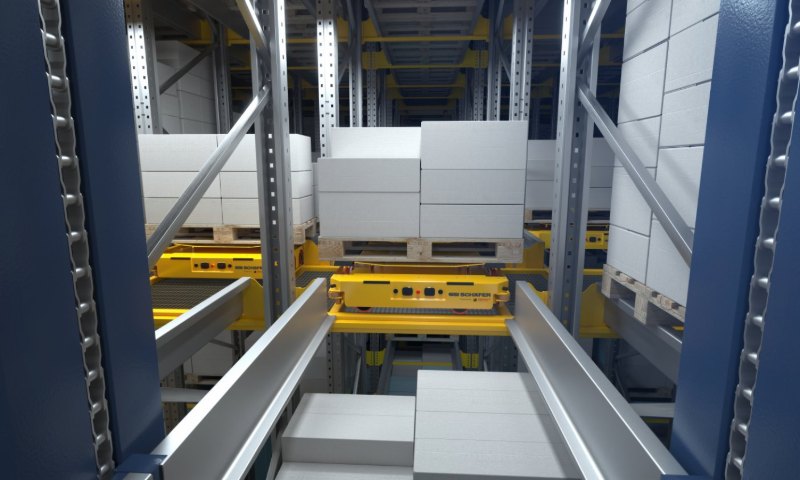
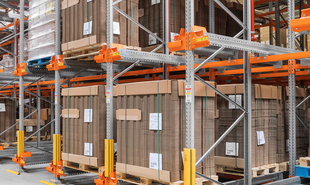
The further requirement for the newly organized intralogistics was to consolidate six warehouses for packaging and production supplies into a single warehouse. For packaging on Euro and industrial pallets, Still installed pallet shuttle racking systems. Shuttles and forklifts operate simultaneously. During semi-automated storage and retrieval, the channel levels are loaded with goods independently. This results in significantly higher levels of safety, density, and flexibility in the pallet shuttle channel storage compared to manually operated drive-in racking. Peak order volumes are handled quickly and flexibly through the simultaneous deployment of all satellite vehicles.
The Nestlé project manager praised the close collaboration with Still: “The automated EXV is a familiar tiller unit and was quickly accepted at the plant. Furthermore, in the event of a system failure, we can immediately operate the tiller unit manually via a switch. This was also an important factor in awarding the contract.”
Author: Gerd Knehr
TERMS FROM THE LI GLOSSARY
Material flowAutomationtransportIn-house logisticsAGV (Automated Guided Vehicle)AGVLI-NEWSLETTER
Every week, the latest logistics news from Switzerland, the EU and the rest of the world.
Subscribe now