Side loader with autonomy option
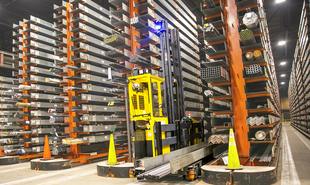
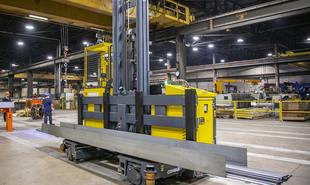
Combilift is now joining the industry's efforts to automate repetitive forklift operations with the AGT autonomous side loader, which was presented for the first time worldwide in Chicago. The machine offers a dual option with the still-available manual mode.
In mid-September, the Combi-AGT garnered significant attention at the Fabtech industrial trade fair on Lake Michigan, as it is the first vehicle of its kind in the side loader category. It is an electric, four-wheeled stationary model and the world's first autonomous side loader with dual operation for transporting long loads.
The Combi-AGT is equipped with the latest smart technology to meet the requirements of an automated guided vehicle (AGV). Key considerations were safety aspects, aiming to eliminate the need for personnel in the aisles, ensure consistent handling procedures, and order processing , while simultaneously providing a manual backup mode in case of power outages or internet disruptions.
Combilift's automation team worked with steel suppliers for over three years to determine the optimal specifications for the Combi-AGT. The new model, with a lifting capacity of 5,000 kg/11,000 lbs and various lifting heights, is tailored to the needs of steel service centers and the metal industry, which typically handle long loads. During the development process, Combilift also collaborated with the Irish Manufacturing Research (IMR), a government-funded technology transfer agency, to ensure seamless integration with the warehouse management systems of various customers.
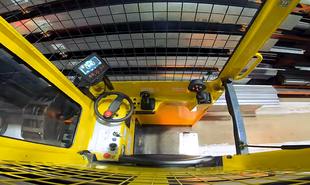

The design is based on the electric, manually operated Combi-GTE model, which has long been a popular choice for service centers due to its efficient operation in rail-guided narrow aisles. The first Combi-AGT unit was delivered to Steel and Pipe Supply in Kansas 18 months ago. Since then, Combilift has collaborated with several leading metal service centers across North America during the development process.
The laser-based sensors, mounted at various points on the chassis, form an anti-collision safety system as required by the American National Standards Institute. If the machine detects an obstacle or a pedestrian who has entered its work area, it automatically slows down and, if necessary, stops. It then automatically resumes driving once the obstacle has left the safety sensor's range. The advanced adaptive safety system allows the size of the obstacle detection fields to be increased or decreased depending on the forklift's steering angle and speed.
The "Natural Feature" navigation system is said to be superior to conventional forklift navigation methods that rely on wire guidance or artificial landmarks such as reflectors. Instead, it utilizes existing warehouse structures, such as walls, shelves, and columns, thus avoiding the need to expand or modify the warehouse infrastructure.
 ▶ VIDEOPhotos: Combilift
The patent-pending system for detecting load dimensions uses a laser scan to check whether the load's length matches the task assigned to the machine. Similarly, during unloading , it checks whether the front rack has enough space to accommodate the load.
Martin McVicar, CEO and co-founder of Combilift: “We deliberately didn’t rush the inclusion of autonomous products in our portfolio. As with any new launch, we conducted extensive field tests to ensure the product fulfills its purpose, collaborating with several leading customers in the metal industry during the product development phase. We are fortunate to have highly motivated employees on our autonomous team, comprised of software, mechatronics, and mechanical engineers, who are committed to scaling this business area.” Further expansion of our autonomous product range is in preparation.
In 1998, Combilift made history with its world's first multidirectional forklift, the C4000, featuring 3-wheel all-wheel drive. 25 years later, the company is still challenging the market, and the Combi-AGT is no exception.
LI-NEWSLETTER
Every week, the latest logistics news from Switzerland, the EU and the rest of the world.
Subscribe now