Continue delivering in the city
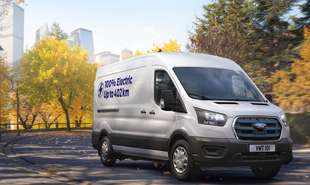
A new 89 kWh battery gives the electric version of the Ford Transit a range of up to 402 km for inner-city and regional delivery traffic, increasing its range by 28%. Charging from 10 to 80 percent of full capacity can be reduced to 28 minutes.
With the electric version, there is currently no risk of restrictions due to increasing regulations, nor of the more than 350 low-emission zones already in Europe.
An "Alexa Built-in" can act as a personal voice recognition assistant with artificial intelligence, providing important information during the journey and answering general questions, while a novel delivery assistant saves more than 20 seconds per stop in delivery traffic – this can add up to more than an hour of working time per day for parcel delivery drivers, for example.

According to the manufacturer, the Ford eTransit found almost five times as many buyers last year as its closest competitor. Customers benefit from longer service intervals: Instead of every twelve months as before, an inspection will now only be required every two years – regardless of mileage. General Pro Manager Hans Schep: "This allows our customers to cover longer distances between charging sessions."
The extended-range E-Transit is aimed particularly at users who operate vehicles in rural areas, colder climates, or on routes with long stretches of highway. Its powertrain is also suitable for conversions or bodywork with increased weight or additional energy requirements. At the same time, the engineers were able to significantly improve charging performance. It now reaches up to 22 kW at AC charging points, compared to the previous 11 kW. With direct current (DC), the new model variant can even charge at 180 kW instead of the usual 115 kW. In this case, just ten minutes are enough to add up to 116 km of additional range .
 Photos: Ford
Pro Telematics software enables fleet managers to easily track the charging performance and energy efficiency of each of their vehicles and to define charging time windows to benefit from more favorable energy tariffs. At the same time, the battery of the E-Transit can be preconditioned to maximize range, or the charging infrastructure can be locked to prevent unauthorized use. In addition to optimizing energy management, fleet managers can map their entire fleet in a single system thanks to clear dashboards and practical analysis tools. It also allows for the combined management of fully electric vehicles, plug-in hybrid models, and conventional company cars, even if they are from different brands.
LI-NEWSLETTER
Every week, the latest logistics news from Switzerland, the EU and the rest of the world.
Subscribe now