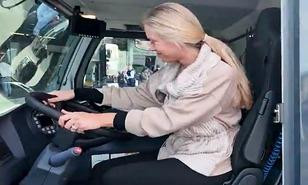
Live demonstration by the bicycle couriers
Numerous providers have now outgrown their infancy and are being integrated by large logisticscompanies to complement their services for "last mile" deliveries. In Berlin, optimists believe that half of all city transport could be done by bicycle. A "MotionLab" is providing support.
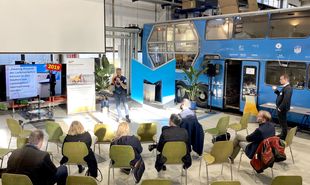
The so-called "MotionLab" on Bouchéstrasse, located on a former industrial site alongside several new businesses and the Federal Criminal Police Office (BKA) just around the corner on Puschkin-Allee, looks exactly as one would expect: a coworking space, a shared workspace in a former production hall with container-sized garages that can be rented as needed. New forms of mobility are taking shape at 3D printers, laser cutters, electronics, textile, and woodworking workbenches, and metal workshops. In addition to the machinery, there are office workstations, a reception area, mail and parcel service, Wi-Fi, meeting rooms and planning desks where visions are born, and a shared cafeteria. There's even an auditorium surrounded by planters and a venerable double-decker bus from the Berlin public transport system, now used as a training room, event center, or even a phone booth. "Only pay for what you actually need" is the motto of the company founders and partners.
 Photos: klk.
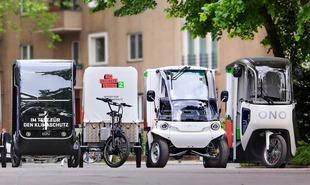
They set up a bicycle course in the yard to showcase the variety of cargo bikes now available to the participants of the German Logistics Congress, who arrived by bus. The bikes included substantial models with containers compatible with Euro pallets, better-equipped pickup trucks, and even extremely narrow ones that, when driven past, resembled a wardrobe on wheels. Almost all of them featured a driver's cab, rearview mirrors, lights (brake lights, turn signals), anti-theft devices, cup holders, a mobile phone mount with a USB port, an ergonomically adjustable driver's seat, reverse gear, and hill start assist. The prices were also substantial, comparable to the cost of a small car. Whether any of the manufacturers would deliver vehicles to Switzerland was answered with reference to registration restrictions, to which such models would first need to be adapted. Ultimately, the motto "think globally, act locally" prevailed. Especially since good brands are already traded in Switzerland that fully meet Swiss standards in terms of quality and reliability.
Tom Assmann, board member of the German Cycle Logistics Association (RLVD), reports that around 13,000 cargo bikes are sold annually. The share of electric and pedal-powered courier bikes in the city currently seems to be stabilizing at 20 to 30%. However, according to cycling enthusiasts, a figure just over 50% would be both possible and sensible, as confirmed by Martin Schmidt, the dynamic and engaging managing director of Cycle Logistics. "But a lot still needs to happen," Assmann remarks regarding the timeframe for achieving such high figures. There is also still room for future development regarding so-called micro-depots and "nano-hubs," including potential automated sorting processes. Schmidt is clear that the "middle mile"—the route to the urban distribution center—is not something that can be effectively managed with cargo bikes, but rather still requires larger vehicles. When it comes to digitizing delivery routes and the interface for last-mile delivery, companies like Amazon would once again have an advantage, because they consistently have good data.
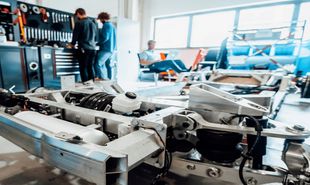 Photo: MotionLab
"Bicycle logistics in cities is actually nothing new."
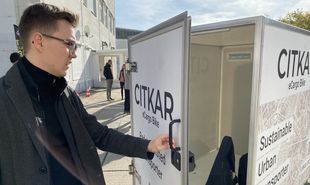
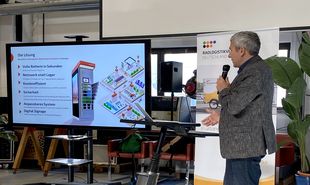
An interesting multi-modal battery swapping station, also demonstrated live in Alt-Treptow, is similar to those used in intralogistics for forklifts , but here it offers purely private benefits. Relatively lightweight batteries from eight different types and manufacturers can be integrated into the exchange system, which includes everything from the constant availability of fully charged batteries and the management of defective ones to recycling, all accessible via an app. Payment is made through a monthly subscription model.
Regarding the general switch to electric cargo bikes, Arne Behrensen, managing director of «Cargobike.jetzt», points to considerable subsidies and purchase premiums that are available, at least in Germany, and amount to sums of up to four figures.
Given the German Federal Association for Logistics (BVL)'s promotion of sustainable methods and concepts, greater participation from attendees of the logistics congress would have been desirable. Only a dozen or so made their way to the outdoor event.
LI-NEWSLETTER
Every week, the latest logistics news from Switzerland, the EU and the rest of the world.
Subscribe now