The Port of Duisburg, a key transshipment point for the Rhine shipping corridor between Basel and Rotterdam, successfully concluded the 2024 financial year with the Duisport Group, even exceeding its targets. Container throughput increased to 3.9 million TEU, and 51 million tons of goods were transported.
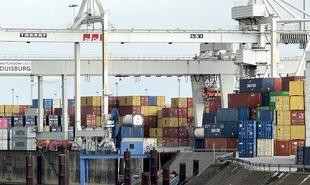 Photos: klk.
As the company announced, the total revenue of the Duisport Group, including the proportionate revenue from non-consolidated strategic investments, rose to €356.3 million (2023: €331.5 million). Duisburg thus lives up to its status as "Europe's largest inland port" By comparison, Hamburg handled 8.3 million TEU in the same year. CEO Markus Bangen: "We have clearly exceeded our economic targets and made up for the crisis-related decline in container throughput".
High investments
Given the numerous political and economic challenges faced, this is a remarkable achievement. In 2024, the group also invested €89.7 million in infrastructure and maintenance measures (2023: €68.7 million). This level of investment is to be maintained in the current year as well.
Despite delays in Germany's nationwide hydrogen rollout, the Port of Duisburg remains a key component of the energy transition. In the future, large quantities of hydrogen derivatives such as ammonia and methanol will be imported to meet industrial demand. At the same time, it is essential to capture CO2 emissions, which are unavoidable in energy-intensive processes, and transport them abroad for long-term storage. As Europe's central logistics hub, Duisport is expected to play a key role in both areas.
hub of decarbonization
“In recent years, there have been intensive discussions about how the energy transition can be achieved in concrete terms – now the implementation begins. We are continuing our growth trajectory, making the Port of Duisburg fit for the future and developing it into a hub for decarbonization”says CEO Bangen.
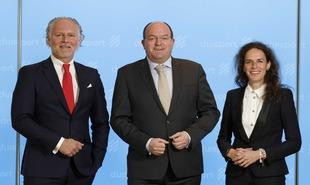 L. Nennhaus, M. Bangen, G. Sperling-Doppstadt. Photo: duisport/M. Stepniak
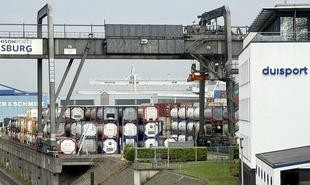
Even today, methanol and so-called liquid organic hydrogen carriers (LOHC) can be stored and handled in the existing tank farms. As part of the second expansion phase of the Duisburg Gateway Terminal, a storage facility for hazardous materials containers is being built, where methanol, ammonia, hydrogen, and other chemicals can be handled and stored in tank containers.
Electrolysis plant under construction
The missing piece of the puzzle is a tank farm for transferring large quantities of ammonia from barges to trains and trucks, which is to be built at the Rhine Quay North in Duisburg-Hochfeld. Duisport and the Dutch developer and operator of liquid bulk terminals, Chane (formerly KooleTerminals BV), have initiated the permitting process for this project. In addition, Duisport, together with Lhyfe GmbH, a pioneer in the production of renewable green hydrogen, is pushing ahead with the construction of an electrolysis plant. This plant is to be built adjacent to the ammonia tank farm.
Furthermore, connections to the planned hydrogen and CO2 pipelines of Open Grid Europe GmbH (OGE) in Duisburg-Hochfeld and Duisburg-Ruhrort are being examined. The pipeline route planning not only investigates the fundamental possibility of connection but also focuses on the optimal route and permitting feasibility. Currently, injection volumes of up to 7 million tons of CO2 and 500,000 tons of hydrogen per year are anticipated.