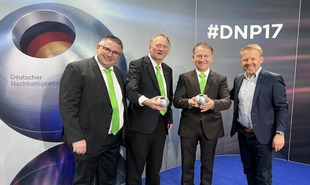
Automotive supplier ZF has won the German Sustainability Award for its circular economy at its Bielefeld plant. There, around 180,000 clutch pressure plates and discs, 10,000 torque converters, and approximately 55,000 release systems are disassembled into their individual components, inspected, and remanufactured each year.
In a total of 25 remanufacturing plants worldwide, the technology group refurbishes used parts on an industrial scale for a "second life" – at the ZF site in Bielefeld since 1963. The jury's decision was based primarily on the remanufacturing of powertrain modules for vehicle manufacturers.
Having already received the sustainability award in the "Company" category of the automotive industry last year, ZF has now won in the "Resource Transformation" field. According to the jury, this is one of the key areas where particular efforts, increased innovation, and rapidly scalable solutions are most urgently needed to achieve the goal of sustainable development. "We are already making an important contribution to resource conservation by continuously increasing the proportion of recycled materials in our products," says Dr. Michael Karrer, responsible for sustainability, environmental management, and occupational safety at ZF.
 Photos: ZF
“Combining economics and ecology is our overarching goal. Our priority is to plan products sustainably from development to remanufacturing,” emphasizes Jörg Witthöft, ZF site manager in Bielefeld. The entire remanufacturing product portfolio is certified according to the “Cradle-to-Cradle” standard for a consistent circular economy. Compared to a new part, material consumption is reduced by an average of up to 95 percent with remanufactured products. According to the company, energy and CO2 savings amount to up to 90 percent.
Thanks to ZF's used parts management program, up to 35 percent of sold products are currently returned to the plant. The Bielefeld site aims to increase this rate to 90 percent within the next five years. Conversely, waste at the plant has been significantly reduced – by around 40 percent since 2019. Not only are the products themselves examined for their recyclability, but also the waste materials. The long-term goal, explains Witthöft, is "to establish a completely waste-free site.".