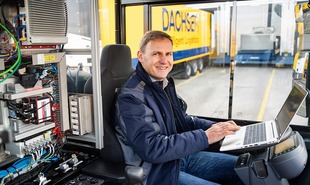
 A. Bilz in the robot cockpit
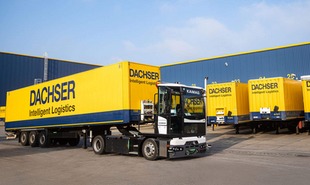
The «Kamag Precision Tractor» picks up a semi-trailer from its parking space and the person behind the wheel leans back in a relaxed manner - in the SAFE20 research project, Dachser in Ulm is testing the mixed operation of human-driven vehicles and fully automated vehicles in company yards.
Autonomous vehicles have great potential in logistics, for example, to fully automate the maneuvering of swap bodies. But how can this be implemented safely and efficiently in a busy freight yard? The transport service provider Dachser in Langenau near Ulm has been researching this in real-world operations. And the two autonomous yard vehicles used here are moving quickly.
Three large, round sensors are located at the front ends and in the center of the bumper of the tractor unit, from which bright green cables branch off into the vehicle's digital interior. Additional sensors and antennas are mounted on the roof.
These robot-controlled vehicles, traveling at speeds of up to 20 kilometers per hour, blend seamlessly into mixed traffic. Accompanied only by a safety driver ready to intervene in case of emergency, the vehicles of the yard logistics specialist Kamag must navigate numerous unpredictable situations, maneuver around obstacles, change direction, and watch out for pedestrians and cross traffic. This presents a significant challenge for the sensor technology and the associated IT systems.
Integrated into the traffic flow
Lidar scanners use laser light to capture the surroundings and create a digital image. A GPS antenna on the roof ensures precise positioning of the vehicle while driving. A second antenna receives data from infrastructure sensors. This is how the evaluated information from radar and camera data is transmitted. "The maneuvering of swap bodies and trailers from parking areas to loading or unloading at the transshipment hall offers considerable potential – especially given the shortage of drivers," explains Stefan Hohm, Head of Development at Dachser.
To enable the complex process of fully safe, automated truck traffic in a logistics facility, cameras and sensors were also installed on the outside of the buildings for the research project. If one of these detects a person, for example, crossing a pedestrian crossing, the autonomous vehicle receives this information in advance. It can reduce its speed and, if necessary, stop immediately, even before it turns the corner and the person comes into view.
 Photos: Dachser
“For mixed operations on our site, it’s crucial that the autonomous vehicles don’t become an obstacle,” says André Bilz, Team Leader Truck & Terminal Equipment at Dachser’s headquarters. Currently, adhering to existing safety regulations, it would only be possible to operate such vehicles at 6 to 8 km/h. The vehicles tested here, however, travel three times faster, at speeds of up to 20 km/h.
For three and a half years, the research project investigated how this works in practical logistics operations. Important foundations were laid, such as a comprehensive safety concept that was validated in continuous operation under real-world conditions. The project results will now be incorporated into the development of legally sound framework conditions for automated freight transport at transshipment points.
Valuable addition
In addition to Dachser, seven partners are involved, including the Fraunhofer Institutes for Material Flow and Logistics IML and for Transport and Infrastructure Systems IVI. ZF Commercial Vehicle Systems from Hanover is acting as project coordinator and was primarily responsible for the conversion of the Kamag PT tractor unit. The two special vehicles, supplied by Kamag Transporttechnik, were equipped by the various partners with the necessary sensors and on-board electronics for data processing. Sick provided the sensors and played a leading role in developing the safety concept. Götting, an automation expert, supplied key components for vehicle localization.
Bilz and R&D colleague Christoph Ehrhardt draw a positive conclusion: "We don't yet have a production-ready solution, but valuable experience and data with which we can shape the future," says Ehrhardt.
Christian Auchter