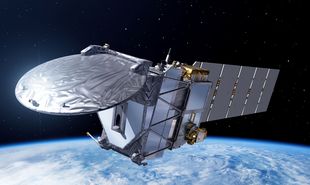
 Image: ESA
A special kind of "CARE package" has now been delivered from the construction site in Immenstad on Lake Constance to the Netherlands by the Paderborn-based large-capacity and heavy haulage company "Universal Transport": The satellite EarthCARE (Cloud, Aerosol and Radiation Explorer).
The transport – at an adjusted speed – proceeded via Hockenheim and Venlo to ESTEC in Noordwijk, Netherlands. The satellite mission is a joint venture between the ESA and the Japanese space agency JAXA (Japan Aerospace Exploration Agency). The launch of this largest and most complex Earth observation mission to date is scheduled for 2023.
After loading at Lake Constance, company employees escorted the three-night transport in a support vehicle. During the day, a security firm guarded the cargo, which was housed in a container. The overall dimensions of 21.50 m x 4.2 m x 4.25 m and a weight of 41.8 tons posed no problem for the heavy transport experts.
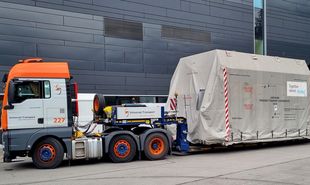 Photo:
“The particular challenge this time lay not in the size or weight of the cargo, but in the high value of the future Earth's satellite,” explains Universal CEO Holger Dechant regarding the cinematic mission. “It is a great honor for us (...) to be able to carry out this transport. After eight months of meticulous preparation, we were able to complete the mission on schedule.”
EarthCARE will utilize high-performance lidar and radar technology never before flown in space. Built by an international consortium, the satellite weighs 1.3 tons and is self-sufficient in terms of power, powered by 1.1 kW of solar cells. It is designed to operate in orbit for at least three years. For atmospheric observation, it carries four instruments: a JAXA Doppler radar for measuring vertical cloud profiles, a camera with seven high-resolution color channels, a broadband radiometer, and a lidar system. The data collected will be transmitted to the ground station at speeds of up to 1.5 Mbit/s.
The goal is to obtain data sets that will allow scientists to study the relationship between clouds, aerosols and radiation with previously unattainable accuracy, in order to better understand the processes of climate change.
www.universal-transport.de