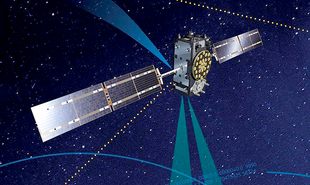
A signal deviation of one nanosecond would translate to a difference of 0.3 meters on the road in space-based time-of-flight measurements for automated driving, which will utilize satellite systems in the future DLR. The Institute of Quantum Technologies considers this excessive and working now on iodine laser clocks for the European navigation system.
The Galileo system contains atomic clocks accurate to the nanosecond. One billion nanoseconds constitute one second. And there's more: "The iodine laser clocks developed at the Institute for Quantum Technologies will be many times more accurate than other systems," says Professor Felix Huber from the Galileo Competence Center at the German Aerospace Center (DLR).
The Competence Center continuously improves the technologies for the navigation system. To this end, inventions from DLR institutes are developed in collaboration with industry so that they can be used for satellites and ground systems. The Institute of Quantum Technologies is contributing iodine laser clocks to a project called "Compasso." These iodine laser clocks must be particularly small, robust, and durable for use in space. A laser terminal has been developedthat transmits the data, synchronizes the satellite clocks, and determines distances with high precision. In addition, a frequency comb and other instruments support experiments in space. The frequency comb converts the optical signals into the frequency range used for satellite navigation. The Institute of Software Technology provides the operating software for the computer that controls the experiments. DLR Space Operations supports and is responsible for the preparation and execution of the overall operation.
“The atomic clocks in the satellites must synchronize so precisely that they allow for positional accuracies in the range of a few centimeters in real time,” says Felix Huber. The satellites continuously transmit data about their onboard time and their orbit. The receiver calculates the distance to the satellite by determining how long the signal takes to travel. Galileo currently consists of a network of 22 operational satellites moving in three orbits. The satellites are controlled by two control centers, one located in Fucino, Italy, and the other at the DLR site in Oberpfaffenhofen, Germany.
www.dlr.de