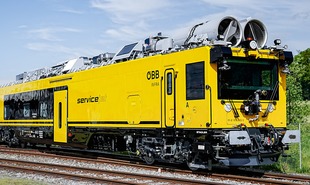
Stadler announces the delivery of the first trimodal rescue train with innovative drive and safety technology in St. Pölten, Austria. Eighteen of the low-emission firefighting and rescue units are to be delivered to the infrastructure subsidiary of the Austrian Federal Railways (ÖBB) and stationed at various tunnel portals.
The vehicles were developed and produced at the Swiss sites in Bussnang and St. Margrethen. 68 meters of state-of-the-art rolling safety, a top speed of 160 km/h in both directions, and a trimodal drive concept are the key specifications of the new rescue train. Its electric-hybrid drive can utilize multiple energy sources: overhead lines, powerful traction batteries, and diesel generators. This enables a completely new firefighting and rescue concept: it can fight its way through a smoke-filled tunnel to the source of a fire, rescue people from derailed trains, tow derailed trains, fight fires, and transport itself and all its equipment to safety from the danger zone.
 Train received: P. Spuhler, J. Pluy
ÖBB Infrastructure CEO Johann Pluy: “The new service jets offer greater performance over a larger operating radius. The new concept allows for a reduction from 21 to 18 vehicles.”
“We were able to meet all of the customer’s quality and safety requirements.” Stadler also builds Kiss long-distance trains and Flirt Intercity and regional multiple units for ÖBB,” says Stadler board member Peter Spuhler.
In an emergency, over 300 people can be accommodated in the three carriages, which are accessible from front to back. 18 seats are equipped with self-contained breathing apparatus (SCBA) holders for firefighters. An air conditioning system with special filters protects passengers from smoke. Furthermore, the entire train set is pressure-tight, allowing the interior to be maintained at a slight overpressure to keep it smoke-free in tunnels. The front section of the train, including the driver’s cab, can be protected from the outside by a water spray system.
Furthermore, the rescue train can be loaded with thematically organized roll containers. These containers transport firefighting equipment such as portable pumps, wildfire fighting gear, breathing apparatus, special protective suits, etc. At ÖBB Infrastructure, the roll containers are stored fully loaded at the depots, stowed in the trains as needed, and unloaded at the incident sites using built-in lifts.
 Photos: ÖBB/Stadler
Two extinguishing systems are available for fire suppression: a high-pressure system (100 bar) for generating a fine spray, for example, to cool a tunnel tube or to wet road shoulders while the train is in motion and protect them from ignition; and a normal-pressure system (10 bar) for conventional fire suppression. The train carries 40,000 liters of water and 1,200 liters of foam concentrate (in the center car). These are dispensed via two high-pressure and one normal-pressure monitor, each mounted at the ends of the train and independently controlled from the driver's cab. Two jet fans are also located on the roof of the train cars, one at the front and one at the rear, which further disperse the water mist emitted by the high-pressure monitors. These fans can also be used during evacuations to create back pressure in a smoke-filled tunnel and prevent airflow reversal. Powerful searchlights and thermal imaging cameras are available for search and rescue operations, enabling emergency personnel to penetrate the smoke.
The "Servicejet" is also to be approved for use on the German rail network. The rescue train will be stationed for the first time at the 33 km long Koralm Tunnel when the Koralm Railway opens.