In Germany, it is said that those who operate a rail siding are largely left to their own devices and make their decisions alone. However, there are also enthusiasts who, in 2013, founded an "ERFA Rail Siding Group" on the initiative of siding professionals, the Fraunhofer IML, and the Prien Regional Center.
In recent decades, many rail connections to industrial sites, which are now often derelict, were dismantled due to a lack of profitability. The ERFA initiative now enjoys the support of the Bavarian Ministry of Transport to offer rail siding owners a forum for exchange and discussion, and to share experiences and challenges related to their own rail connections. ERFA now has over 40 members, with ERFA groups in Bavaria, Lower Saxony (Hanover), and, since this year, also in Saxony-Anhalt.
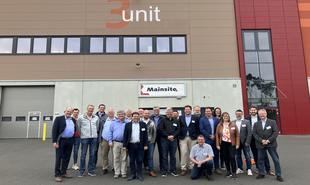
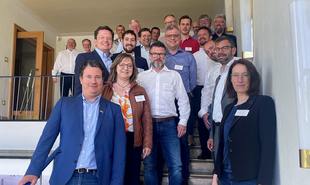
Last week, the ERFA group met in Bavaria at the premises of one of its members in Obernburg am Main. Mainsite GmbH & Co. KG hosted the event at the Obernburg Industrial Center (ICO). In his introductory remarks, Andreas Schneider, Head of Real Estate & Site Development, explained that the ICO has been producing primarily technical fibers and yarns since 1924, which are used today in products such as airbags, seat belts, car tires, and clothing.
The site has continuously adapted to changes and new circumstances over the past nearly 100 years. This is the only reason it has survived to this day in the Bavarian Lower Main region as one of the few remaining fiber industry locations in Europe. For the region, the ICO provides 3,000 jobs, 250 apprenticeships, significant business tax revenue, a state-of-the-art power plant that can reliably supply around 200,000 people in the region with electricity when needed, a company fire brigade that also supports the surrounding communities, and much more.
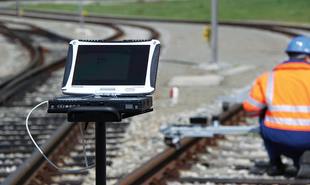
During a tour of the ICO (Industrial Center), the ERFA (Experience Exchange) members were able to gain an impression of the new logistics facilities, including the logistics center, which has been operational since 2019 and covers an area of approximately 71,000 m², and the railway infrastructure. Martin Franke, Deputy Head of Rail Transport Wagon Dispatch at ARS Altmann, reported on his experiences working with DB Netz AG (German Rail Network) and the impact of the Riedbahn railway line between Mannheim, which is scheduled for renovation starting in July 2024 at a cost of around €500 million.
In his subsequent presentation, attorney Andy Niekamp provided information on the changes to the new track connection law in Germany, as stipulated in Section 13 of the AEG (General Railway Act). This law governs the drafting of new contracts for connections to other railway infrastructure. ERFA moderator Andreas Krapf, project manager at the Logistics Competence Center (LKZ) Prien, appreciated the organizational work of the mainsite operator company, managing director Andreas Schneider and logistics/operations manager Hans-Jörg Schramm.
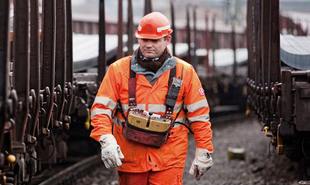
In Germany, since January 2021, there has indeed been a "Guideline for the Promotion of the Construction, Expansion, Reactivation, and Replacement of Rail Sidings and Other Rail Freight Facilities," and for this purpose, state funding is available from the Federal Ministry of Transport and Digital Infrastructure "for the construction, reactivation, expansion, and replacement of rail sidings and multifunctional facilities, as well as feeder and industrial spur lines." The overarching goal is to shift a portion of freight traffic from road to rail and to ensure the long-term viability of such traffic on the rail network. The specific objective of the rail siding funding guideline is to avoid an average of 31,000 truck journeys per €1 million in funding.
New members of the Erfa (Experience Exchange) receive a corresponding handbook containing a collection of the most important regulations, links, and experiences.
www.erfa-gleisanschluss.de
www.lkzprien.de/