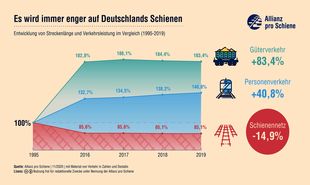
Although the Transport Minister has his Federal Office for Goods Transport the Federal Office for Logistics and Mobility (BALM) renamed he would verbally be "at the forefront" again. the German "Alliance for Rail" criticizes However,the fact that Germany still ranks near the bottom in per capita investment in rail.
Dirk Flege, managing director of the Alliance for Rail, admitted in Berlin on Thursday that Germany "invested more in its rail network last year, at €124 per capita, than ever before." This could be considered – with a touch of irony – a real boost for rail transport. However, Flege pointed out that other European countries have also "significantly increased" their public investment in rail networks, meaning that Germany ranks only slightly ahead of Italy in a European comparison. Luxembourg, Switzerland, and Norway are the leaders in this European comparison.
The association, together with the consulting firm SCI Verkehr, annually determines how much money selected European countries invest per capita in rail infrastructure. Luxembourg led the way in 2021 with €607 per inhabitant, followed by Switzerland with €413. Norway, with per capita investments of €315, came in third for the first time. Austria, with €271, ranked fourth, also placing it among the top performers. Germany lagged far behind the UK (€158), Denmark (€157), and the Netherlands (€147), ranking just ahead of Italy (€103).
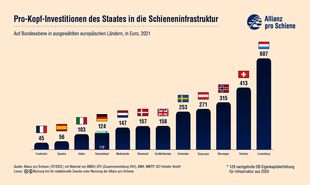
The significant increase in investments in Germany from €88 per capita in 2020 to €124 per capita in 2021 is "partly due to a one-off effect." The funds provided by the federal government in connection with the 2030 climate protection program for the equity increase of Deutsche Bahn were also retroactively disbursed in 2021 for the year 2020. "Following this one-off effect, a further decline in Germany's per capita investments in 2022 is already inevitable," said Flege, referring to the budget for the current year. "This is neither in line with the ambitious goals of the current coalition agreement nor with the continued increase in rail transport demand," Flege added.
“Germany’s rail network is groaning under the weight of traffic. The demand for freight and passenger transport by rail is enormous. More and more companies and people want to use the railway, but encounter capacity bottlenecks because the rail infrastructure is undersized and underfunded. The worst part is that Germany is also lagging far behind other EU countries in the digitalization of its rail network,” said Maria Leenen, Managing Director of SCI Verkehr.
In a recent study entitled "ETCS Development until 2030 in Europe," SCI Verkehr examined the progress of the digitalization of European rail networks. According to the study, Germany, unlike other countries, is planning hardly any significant measures by 2030 and will clearly miss its self-imposed target of equipping all federal rail lines with the European Train Control System (ETCS) by 2035. Leenen: "If the projects and political decisions known today remain unchanged, digital rail will still not be a reality in Germany by 2040, while countries like Belgium, Denmark, and Switzerland have long since completed their homework and are thus enabling seamless rail services across Europe."