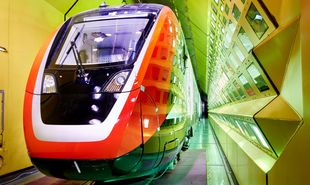
 Photo: SBB
SBB has rejected the idea of high-speed cornering with so-called tilt compensation on long-distance double-decker trains (FV-Dosto); recent test runs have shown that the highly complex tilting technology is "comparatively prone to errors", expensive to maintain and not future-proof.
The passenger comfort of the FV-Dosto is to be improved in other ways. SBB continues to explore options for reducing travel times between Bern and Lausanne, as well as between Winterthur and St. Margrethen.
The so-called "high-speed curve" trains will definitely be discontinued. SBB had planned to introduce them from 2027 onwards to create more buffer time in the timetable during upcoming construction work. Subsequently, from 2036, the plan was to reduce travel time without expensive infrastructure upgrades, first between Lausanne and Bern, and then between Winterthur and St. Margrethen.
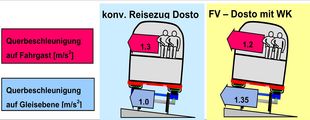
The decision to implement roll stabilization was made by Swiss Federal Railways (SBB) based on the then-current state of technical knowledge, promising studies, and successful test runs with converted IC2000 trains. Roll stabilization was considered a technology of the future.
However, the past ten years have shown that while technologies for niche markets and highly complex custom designs like roll stabilization are technically feasible, test runs with the FV-Dosto (double-decker train) have clearly demonstrated that the ride comfort in practice would be unsatisfactory.
Consequently, the FV-Dosto is to be replaced by standard rolling stock after its service life ends in the mid-2040s. According to SBB CEO Vincent Ducrot, SBB has now commissioned the manufacturer Alstom to examine how the train's ride comfort can be further improved and has initiated a corresponding feasibility study.
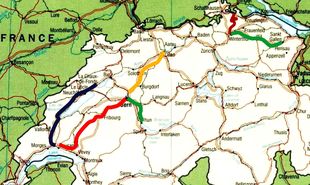 SBB Test Tracks:
As part of scheduled track renewals, SBB has so far invested 32 million Swiss francs in enabling high-speed cornering between Bern and Lausanne. Even high-speed cornering would have required further track upgrades.
The five-minute travel time reductions between Lausanne and Bern from 2036 onwards, and the two-minute reduction between Winterthur and St. Margrethen at a later date, cannot be achieved by foregoing high-speed cornering. For the Lausanne–Bern route, SBB prioritizes a new line. A study commissioned by the federal government is currently underway and is expected to be completed by autumn. SBB intends to follow the same approach and commission a study for the Winterthur–St. Margrethen route.