
 Pierre de Meuron
According to Peter Sutterlüti, president of the board of directors of Cargo sous terrain (CST), planning for the underground freight transport project is progressing. Following the positive parliamentary decision at the end of 2021, the building permit procedures are being initiated along the first section. Architect Pierre de Meuron welcomes this development.
In addition to concrete planning steps for the first section, which open in 2031 would, Cargo sous terrain (CST), in cooperation with cities and cantons, is creating the conditions for the nationwide network. In eastern and western Switzerland, has been CST recent to strengthen the foundation for implementation and in the Zurich region begin a first phase. This phase includes the regional planning procedures inthe cantons of Aargau, Solothurn, and Zurich, which at the end will begin and are a prerequisite for CST. At the World Economic Forum, Basel-based architect Pierre de Meuron also expressed his support for the project in a video message .
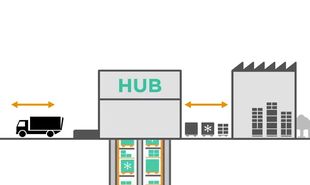
At the current stage, says Sutterlüti, examinedare being suitable hub locations is to integrate the hubs sensitively into the landscape and the populated area. CST offers the opportunityto create landmark infrastructure projects and reduce surface traffic. Parallel to the planning of the first section, CST is working on expanding the network to cover all of Switzerland by 2045. In several cantons, has in recent important milestonesreached.
Eastern Switzerland wants rapid connection
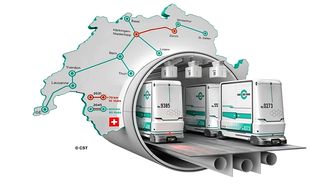
Together with the cantons of St. Gallen and Thurgau, CST conducted a feasibility study that examined the viability of underground freight transport between Zurich and Eastern Switzerland based on freight volumes. The study showed that extending the network to St. Gallen is. Based on these findings, further investigations are now being carried out at potential hub locations. The cantons of St. Gallen and Thurgau are pleased with the positive results and are aiming for the fastest possible connection to the system.
Potential in French-speaking Switzerland
A feasibility study conducted in collaboration with the cantons of Vaud and Geneva confirmed the economic viability of connecting to the CST network in French-speaking Switzerland as well. The partial shift of road freight traffic underground wouldalso to the Lake Geneva region bring . As in eastern Switzerland, intend to conduct further studies on the CST connection, specifying the advantages and practical feasibility.
Zurich: Reliefat the airport
and FZAG CST recently signed a Memorandum of Understanding with Flughafen Zürich AG (FZAG), which has held a stake in CST since 2019. CST intend to connect the airport with the first section of the project. This willrelieve traffic congestion on the access roads while simultaneously managing logistics flows at the airport. Constructionwill involve a branch line from the main tunnel. CST will be the tunnel and vertical conveyor systemresponsible for, while FZAG will construct the actual logistics terminal building.
In the city of Zurich, CST is supporting the municipal authorities in a pilot project for the drop-off and pick-up of parcels. The "SalüBox" aims to consolidate the booming parcel delivery traffic and relieve residential areas of delivery congestion. The city of Zurich, with CST as its implementation partner, will test the concept at four locations within the city limits starting this fall. This partnership is part of CST's city logistics activities to reduce urban traffic and emissions even before the tunnel's opening.
www.cst.ch