The days of unlimited supply chains are over. Global just-in-time supply chains are now on new leadershipThe 20th Logistics Day of the Kühne Logistics University (KLU) in Hamburg focused
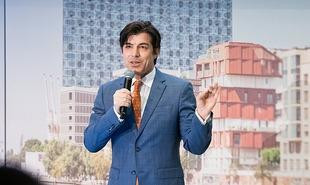 A. Kaplan.
More than 200 specialists and managers gathered at the Kühne Foundation's university, headquartered in Schindellegi, to discuss, under the motto "From Disruption to Direction: Leading the Future of Logistics and Supply Chain Management"how companies can navigate uncertain times – and what new leadership skills are required. "Disruption is no longer the exception, but the norm. Companies need guidance and sound judgment"said Professor Andreas Kaplan, President of KLU, at the opening ceremony.
Disruptions are the norm
“Logistics has always been good at balancing conflicting objectives: speed versus sustainability, resilience versus efficiency, automation versus human judgment. If anyone is exceptionally well-positioned to lead in uncertain times, it is those responsible for logistics and supply chain management.”
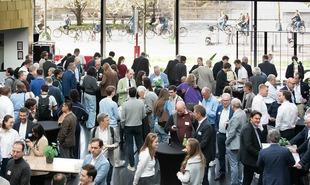 Photos: J. Konitzki
John Manners-Bell, founder of the Foundation for Future Supply Chains, London, and CEO of Ti Insight, outlined a paradigm shift in his keynote address: “Global supply chains have lifted millions out of poverty and driven economic growth. But the model is under pressure. Supply chains are increasingly being used as a political tool.”
Practical example: Nike
Global trade has fundamentally changed due to protectionism, trade conflicts, and geopolitical tensions. Chinese exports to the US fell by 29.7 percent in 2025 due to tariffs, while exports from Southeast Asia (ASEAN) rose by 28.9 percent. "This is not a decline in global trade, but a redistribution – companies are actively restructuring their supply chains"says Manners-Bell.
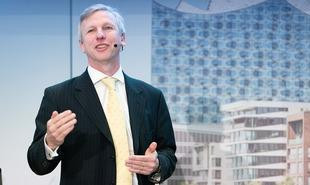 J. Manners-Bell.
A concrete example is provided by the world's largest sporting goods manufacturer, Nike: Tariffs on Chinese exports cost the company around one billion dollars in additional expenses. Nike's production share in China has been declining significantly for years, while production is being shifted to Vietnam (50 percent of shoes), Indonesia, and the Philippines. "Nike has launched a five-year supply chain transformation – and faces the choice of raising prices, relocating production to other parts of Asia, the USA (reshoring), or Mexico (nearsourcing), or reducing margins"says Manners-Bell.
One billion in additional costs
Niklas Wilmking, Managing Director of the Kühne Foundation and former Head of Logistics at DB Schenker: “It’s no longer primarily about moving goods efficiently, but about implementing strategic goals under uncertainty. The best leaders will be those who take responsibility for invisible structures and uncomfortable conflicts of objectives.” Regarding AI, he says: “The bottleneck in the future will no longer be computing power, but leadership in the sense of prioritization and accountability.”
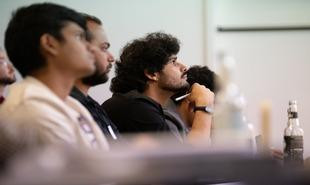
The Kühne Foundation's Logistics Day is supported both in terms of content and organization by KLU and took in 2026 on the Hamburg campus in cooperation with HELP Logistics and the Kuehne Climate in specialized sessions at the Kühne Foundation's AI in supply chain planning, CO₂ removal technologies, humanitarian Logistics Day.
Over 200 participants
The Kühne Foundation sponsors the Kühne Logistics University in Hamburg, supports logistics professorships at renowned universities, and is also active in the field of humanitarian logistics. Furthermore, it is heavily involved in medical projects in Davos, Switzerland. In the cultural sphere, the Kühne Foundation supports festivals, opera houses, and concert halls in various European countries.