in the coming years, with a share of 52%, ahead of cleaning (13%), hospital (21%), and most from automation and . Humanoid robots are still lagging somewhat behind, but are catching up.
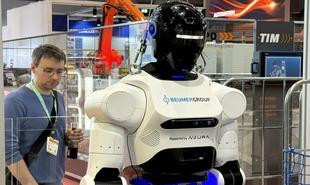
“How much human interaction will the warehouse of the future need?” Professor Alice Kirchheim, head of the Fraunhofer IML, addressed this question at the opening of this year’s LogiMAT trade fair in Stuttgart, together with experts, exploring the extent to which it will even be necessary to develop artificial beings modeled on the human form. After all, there are already numerous machines, mobile assistants, and “tin companions”that are increasingly successful in performing tasks tailored to very specific applications within transport and material flow processes.
 Prof. A. Kirchheim
“We will need some time to come, during which we will still rely on human tasks that cannot be replaced by robotic systems,”points out Arne Flemming, Head of Supply Chain Management at Bosch. While artificial intelligence has now solved problems such as balance and stability on a larger scale than the rather clumsy balancing exercises at the research level around the turn of the millennium would have suggested ,why“adds Flemming shoulda robot even look like a human?”

At approximately one in ten exhibitors' stands at LogiMAT, humanoid figures are now milling about , either pouring drinks or handing over a screwdriver, but as a precaution still suspended from a kind of gallows so that their considerable weight, due to heavy batteries, could not cause them to trip over onlookers and give rise to claims for damages .
Complete armies
YouTube videos now showcase entire robot armies, primarily in China, performing synchronized parades. "But we don't even know if some of these videos aren't generated or 'supplemented' by AI"says Kirchheim. "The world won't completely change through the use of robots"says Volker Jungbluth, Chief Technology Officer at the mechanical engineering and automation provider Beumer, which has just signed an EnterpriseLab cooperation agreement with the Fraunhofer IML.

Nevertheless, efforts continue to focus on refining applications that will find their place in mining, baggage sorting, intralogistics processes, and airport applications. Xia Huiling of Libiao Robotics agrees with the panelists' assessment that it will likely take another five to six years before the handling quality and stability of humanoid designs become robust enough to be beneficial in real-world environments .
Consider practicality
This is naturally accompanied by the recurring question of whether it is necessary to design humanoid robots that would allow them to replace the many roles humans play, who still have to intervene to set up the robot, right it when it stumbles, and maintain its functionality. Mobile robotics is making progress here with driverless transport systems – “but no one will ever get the idea of putting a humanoid behind the wheel of a car” (Jungbluth).

To further advance the topic, the Fraunhofer Institute for Material Flow and Logistics IML examined the potential for the logistics industry in a white paper. The market analysis identified approximately 80 different systems, varying in mobility, sensor technology, and software, revealing a highly fragmented market dominated by non-European suppliers.

Overall, humanoid robotics is still in its early stages of development, but offers considerable long-term transformation potential for logistics, according to the authors. "Form follows function! Humanoid robots should be understood as flexible, multi-purpose robots that can operate in environments designed for humans. Developing the necessary capabilities is a goal we intend to pursue within the framework of the Federal Ministry of Education and Research's high-tech agenda ," explains the institute director at Fraunhofer IML.

"The study shows that the logistics industry views humanoid robots with great interest, but also with a realistic assessment of the current state of development. Around three-quarters of the companies surveyed expect them to be used productively within the next ten years. From the companies' perspective, humanoid robots should not replace humans, but rather serve as flexible, generalist automation units for existing work environments."
The time to act is now: Operators, integrators, and manufacturers are called upon to establish testbeds and promote open standards and partnerships. At the same time, Europe must invest more heavily in the development of autonomous systems to ensure its technological sovereignty. The researchers from Fraunhofer IML involved in the study presented the results at LogiMAT in Hall 1, Booth 1K61.
here. complete study results