Refrigeration units can break down, temperatures can be set incorrectly, checks can be missed, and errors can occur at the loading dock: The traditional "Ofenhock" of the SVTL in Oberkirch addressed all the things that can happen during temperature-sensitive transport and how precautions can be taken, even with "Kümmel".
Losses incurred during freight incidents, whether caused by technical errors or human negligence, and involving pharmaceuticals, electronics, or food, can quickly amount to six- or seven-figure sums in a single container due to the sensitive and perishable nature of the goods. The presentations by competent industry experts, who, at the invitation of the Swiss Association, provided around 40 participants with insightful perspectives on the world of insurance in "dynamic sectors" such as the sea transport of fresh meat, claims handling, and the workings of modern insurance companies, met with great interest at the conference venue in Oberkirch.
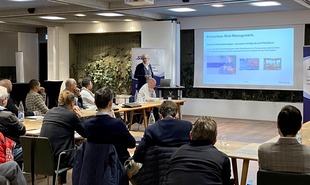
 Th. Keller, NVC Insurance
Anyone who expected dry numbers and statistics was pleasantly surprised by, among other things, the lawyer Marc Friedrich, head of the recourse department of the consulting firm Reck & Co, which has offices in Bremen and Basel and regularly deals with expert opinions, damage cases and recourse claims, and was confronted with some striking examples.
The supply chain is fraught with pitfalls, the effects of which are not immediately apparent – because they arise covertly – and often require considerable expertise to pinpoint the causes. Reefer containers designed for refrigerated transport may initially exhibit unremarkable temperatures upon arrival at their destination. Only data loggers, temperature recorders, and so-called "Temp Tales," which track the progress and even short-term interruptions of the cold chain, reveal damage, the causes of which can sometimes be traced back to temperature differences of just a few degrees – or even fractions thereof.

Because different temperature zones can occur within a single container, even just a few meters apart, sensors should be positioned at spatially staggered locations within standard containers, at both ends and at half and full height, for data collection. Adequate air circulation is also crucial during loading, as neglecting this and the resulting temperature discrepancies have led to unpleasant surprises for many shippers. Equally important are pre-cooling and pre-tempering of the containers, as well as pre-trip inspections, which are sometimes commissioned on a random basis by local insurance companies.
An example presented by Friedrich illustrates the meticulous handling of fresh meat: a shipment of 478 cartons containing 12 tons of beef from Montevideo to Rotterdam. A seemingly simple temperature of -1.4 degrees Celsius was required, as even slight temperature fluctuations can negatively impact the premium fresh meat. A brief temperature increase on one day in April was quickly corrected and brought back to the required temperature.
However, the freezing point of fresh meat is between -1.5 and -1.8 degrees Celsius (in reality: -3 to -4 degrees) – and not exactly 0 degrees Celsius, as is the case with water. Meltwater collected in the packaging, soaking a third of the product and rendering another third inedible.
The shipping company claimed the cargo had already been loaded in Montevideo at an excessively high temperature. Data loggers had recorded the temperature spike, while the transport contractor claimed there were "no recording devices on board at all." Since data sets can also be manipulated and, depending on calibration and certification status, contested, a settlement was ultimately reached, according to Friedrich.
“Unfortunately, international maritime law is not uniform,” says the expert. Jurisdictions and legal systems in New York, London, or Marseille can lead to vastly different rulings. The legal situation is determined by previously concluded agreements signed by the parties involved, which “are often not read carefully,” (…) and – if applicable – by international conventions, such as the Hague-Visby Rules. The latter date back to 1968.
 The conference venue in Oberkirch (LU)
Markus Minder of Helvetia, which has a specialized division ("Specialty Lines") focusing on engineering/technical, transport/marine, aviation, space, and art transport in Switzerland and international markets such as Asia and Latin America, confirms the importance of the "fine print" and explicit risk management in security measures. As a precautionary measure, insurers often cover up to 100,000 Swiss francs to allow on-site inspections by inspectors to verify the correct handling of the goods, including, for example, ensuring the correct temperature is maintained.
Of course, cargo theft is also a risk in the trucking industry, with 919 incidents registered across Europe in June alone – 109 of them in unclassified parking areas. Insurance companies emphasize that truck drivers should check the integrity of seals, doors, locks, and latches after every stop. To prevent the accidental carrying of stowaways, it is even recommended that, on journeys to Great Britain, no breaks should be made at all 200 km before Calais and before the Eurotunnel – and that the terms and conditions should stipulate that the carrier is not liable for damages caused by stowaways.
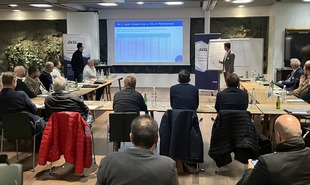 Photos: klk/Chr. Pauli
Speaking of "insurance," the SVTL board decided to give Thomas Keller and Tobias Spychiger from the insurance provider NVC, a new member, the opportunity to present their vision of modern employee insurance and optimized retirement provision through an adapted occupational pension structure in accordance with the Swiss Federal Law on Occupational Retirement, Survivors' and Disability Pension Plans (BVG). "Caraway" played a special role here: namely, as an acronym for "Control, Overview, EmployeeOrientation, MarketAnalysis, Savings, and Solutions," which the two humorously distributed to the participants as a "reminder" in the form of pretzel sticks with – ditto – real caraway seeds. SVTL President Marco Manzetti and other participants, such as STEF Managing Director Hanspeter Harnisch, confirmed that occupational pension provision remains a large gray area for young people entering the workforce. "Most people couldn't care less about pension conditions at that point." This makes providing advice in this area all the more important.
Note: If the customer is poorly insured, the giggling will quickly come to an end.