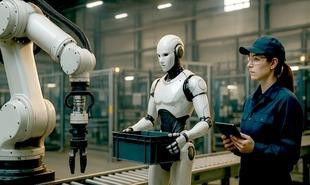
Comparisons between the benefits offered by 6-axis industrial robots, such as "Horst" from Fruitcore Robotics, and new humanoid models are fueling the debate about the "added value" of humanoid "logistics assistants" Benjamin Brumm from Fruitcore is advocating for the simpler option.
 Photos: Fruitcore Robotics
Robotics, says the marketing manager of the Constance-based company, is currently experiencing a two-pronged paradigm shift. "On the one hand, 6-axis industrial robots are achieving new performance records and, above all, are becoming increasingly easy to operate"On the other hand, humanoid robots, for example from Figure or Tesla, are making headlines and generating pilot projects. BMW is already testing humanoid assistants in the USA to repack material boxes and relieve operators. (...)
Enormous expectations
Humanoid robots have been generating enormous expectations since 2025 because they can be integrated into existing production halls without modification and easily handle a wide variety of tasks. According to a 2025 study by the Fraunhofer Institute IPA (which has been cited several times by LogisticsInnovation.org), 80% of German industrial companies consider their use in production and logistics realistic within this decade.
However, the same study also showed that mature 6-axis industrial robots – from compact 3 kg to 500 kg heavy-duty models – already offer the highest precision, cycle times of less than three seconds and demonstrably short amortization periods.
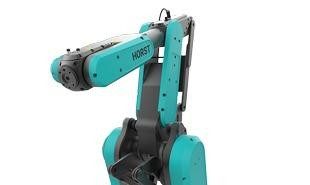 A "Horst" Fruitcore
(…) Although several manufacturers – most notably Figure, Agility, and Apptronik – have presented functional prototypes, the majority of units are in pilot or pre-production testing with quantities of fewer than 100. In the fall of 2024, BMW announced a pilot project with humanoid robots from Figure at its Spartanburg, USA plant.
Not yet mass production
Announcements of four- or five-figure production numbers, on the other hand, are primarily based on manufacturer statements and should therefore be viewed with skepticism. Analysts estimate that "mass production" will be further delayed, for example, due to a lack of standards, energy efficiency issues, and reliability problems.
A working group, "ISO TC 299/WG 3," is currently working on a draft standard that aims to bring bipedal robots closer to ISO 10218-1/-2 (for industrial robots and cobots). It is expected to be adopted by at least 2027.
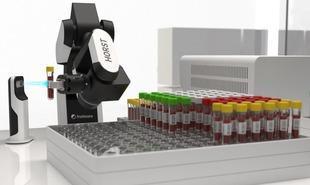
In contrast, millions of 6-axis industrial robots have been successfully used for decades, often in continuous 24/7 operation. (...) Spare parts logistics are correspondingly sophisticated. Furthermore, the standards have matured over many years, ensuring clear regulations for safe automated operation. Specialized grippers, safety devices, infeed and outfeed systems, as well as software solutions, exist for almost every application. (...) Increasingly user-friendly operation, for example through no-code programming such as Fruitcore's "Horst OS"reduces the complexity of the installations.
Question about stability
Humanoid robots are acknowledged to have the potential to fill gaps in the future, primarily where traditional robotics falls short due to their design limitations. They can carry boxes, climb stairs, or utilize existing workbenches. Put simply: they can adapt to human-centered work environments.
The downside of this flexibility, experts say, is reduced pathstability.Repeatability cannot be precisely assessed due to a lack of ISO measurements, but according to live presentations, it is in the low centimeter range.
 fiercely competitive future market
Current humanoid prototypes can handle a maximum payload of 25 kg. Furthermore, the published end-to-end latency of the image-based control loops is only around 110–120 ms. Realistic walking speeds of 1.4 m/s result in a one-second cycle time loss, a major reason why humanoid pick-and-place tasks currently take five seconds or more.
And: According to the manufacturers themselves, the humanoid pilots are designed for less than 20,000 operating hours, while 6-axis models achieve values exceeding 50,000 hours.
«Half the price of a new car»
The key strengths of typical 6-axis robot arms are their high repeatability, often ± 50 mm, and their enormous dynamics in applications such as arc welding or precision bonding. Path speeds well above 2 m/s are easily achievable for 6-axis robots today. Pick-and-place cycles of under three seconds are equally common. Payloads are also incomparable to those of humanoid robots; there are heavy-duty models that can move components weighing several tons.
Well-known manufacturers like Tesla, Figure, and Unitree cite medium-term target prices of $ (€8,600 to €25,800) for humanoid robots. Tesla CEO Elon Musk stated that by 2024, the "less than half the price of a car"In reality, experts estimate that initial proof-of-concept models cost between $ (€130,000 to €260,000). This is because, in addition to the humanoid robot itself, safety systems for object recognition (LiDAR), high-performance edge servers, and specialized grippers are required; the lack of CE conformity necessitates human supervision and thus higher personnel costs.
Furthermore, the current operating time limits for humanoid robot batteries are two to four hours. Cells for 6-axis robots start at around €50,000, depending on the model and desired performance. Plug-and-produce solutions with pre-tested CE conformity drastically reduce internal engineering effort.
B.Brumm / Fruitcore Robotics
Here is the full article by B. Brumm